Understanding Pointers and Arrays in C Programming
220 likes | 373 Vues
This chapter provides a comprehensive overview of pointers and arrays in the C programming language. It explores key concepts such as pointers, addresses, and how they interact with function arguments and arrays. Readers will learn about address arithmetic, multi-dimensional arrays, pointer to pointer concepts, and function pointers. The chapter details the syntax and usage of pointers, memory allocation techniques, and practical examples for manipulating arrays. This fundamental knowledge is crucial for efficient memory management and optimization in C programming.


Understanding Pointers and Arrays in C Programming
E N D
Presentation Transcript
Chapter 5 : Pointers and Arrays Present by : Le ThiHien
Contents • Pointer and Addresses • Pointer and Function Arguments • Pointer and 1-dimensional Arrays • Address Arithmetic • Pointer and Multi-dimensional Arrays • Pointer to Pointer • Pointer Arrays • Function Pointers
1. Pointer and Adresses • A pointer is a variable which contains the address of a variable. • Form : data_type *pointer_name; • Eg : int *p, *q, a;//a is variable int x = 2; //p, q is pointer. p = &x; float y; p= &y;//error p = &(int) y;
1. Pointer and Adresses • int *p, *q;
2. Pointer and Function Arguments Result :
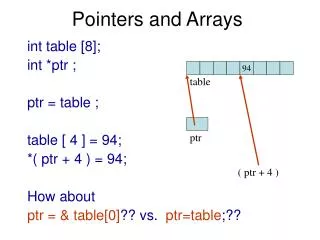
3. Pointer and 1-dimensional Arrays • int a[10]; int *p; p = a; or : p = &a[0]; • scanf ( " %d ", &a[i]); ( 1)scanf ( " %d ",a + i); ( 2)scanf ( " %d", p + i ); ( 3) scanf ( " %d", &p[i] ); ( 4) (1), (2), (3), (4) is the same effect. Result : ?
3. Pointer and 1-dimensional arrays If use : amess = “run out of time”
3. Pointer and 1-dimensional arrays • 4 functions have the same effect : 1. 2. 3. 4.
4. Address Arithmetic • The goal of using pointer ??? • Increase the processing speed • Save memory • Make affect to data when use function. • To allocates a block of memory : void *malloc(size_t size); void *calloc(size_t n, size_t size); • To reallocates : void realloc(void *pointer, size_t size); • To free : void free (void *ptr);
4. Address Arithmetic • Eg : • int *a = (int*)malloc(10 *size(int)); /*declarate and allocates an array contains 10 int elements*/ • int *b = (int*)calloc(20, sizeof(int)); /*delarate and allocates an array contains 20 int elements*/ • a = realloc(a, 20*sizeof(int)); /*extend a array more 10 elements.*/ • free(a);/*need free memory*/ • free(b);
5. Pointer and Multi-dimensional arrays • Form : data_typea_name[][]..[]; • Eg : • Using array with index:
5. Pointer and Multi-dimensional arrays - Using pointer :
6. Pointer Arrays • Form : data_type *ptr_name[elements_number]; • Compare : int a[2][3]; And int *b[2]; a[0] a[1] a b
7. Pointer to pointer • Eg : int a = 3; int *b = &a; int **c = &b; int ***d = &c; *d = c **d = *c = b ***d = **c = *b =a Lineptr[MAXLINES]
7. Pointer to pointer • Eg : #include<…> #define MAXLINE 5000 char *lineptr[MAXLINE]; intread_lines(char *lineptr[], intnlines) { char *p, line[MAXLEN]; … line[nlines++] = p; … } void write_lines(char *lineptr[], intnlines); void swap (char *v[], int I, int j); • void q_sort(char *lineptr[], int left, int right) • { • … • void swap(char *v[], int i, int j); • … • swap(lineptr, ++last, i); • … • } int main() { … read_lines(lineptr, MAXLINES); q_sort(lineptr, 0, nlines); write_lines(linptr, nlines); } Pointer Arrays Pointer to pointer
Function Pointer and Pointer Function • In C, function name ís the address of that function. • Can assigment a pointer to function name. • Form : • data_type (*func_name)(argument _list); /*pointer to function*/ • data_type *func_name(argument_list); /*function which return a pointer*/ • Goal : Charge a function as a argument of other function
Function Pointer and Pointer Function • Eg : … void qsort(void *lineptr[], int left, int right, int (*comp) (void *, void *)); intnumcmp(char *, char *); … intmain() { … qsort((void **) lineptr, 0, nlines– 1, (int (*) (void*, void*)(numeric ? numcmp : strcmp)) ); … }