Different colours-the same meanings Hungarian folklore
150 likes | 275 Vues
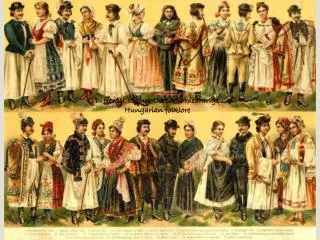
This exploration of Hungarian folklore highlights the roles of color and traditional attire in expressing identity, social rank, and cultural customs. From the 16th to 19th centuries, clothing varied by social class—village peasants, craftsmen, and nobles wore distinct styles. Traditional garments, made from linen, wool, and leather, feature specific items for everyday and special occasions. A woman’s attire conveys her age and status through color; for instance, black suggests maturity while white or bright hues indicate youth. Discover how these clothing customs shape identity and social interaction.


Different colours-the same meanings Hungarian folklore
E N D
Presentation Transcript
Differentcolours-thesamemeanings Hungarianfolklore
Its main functions: • Protectour body • Decorate • Emphasizesocialrank Clothingatall
„Dresscode”: writtenrulesaboutwhere and whattoweardependingonoccassionand status sincethe 16th century • Duringthe 16the, the 17th and the 18th centurysimilaritiesondifferentlevels. Theselevels: • Villeins/peasantry • Craftsmen/civilians • Nobles/landowners • The 18th and 19th centurybrought more colours and a widerange of materials. Clothingbecame more „civilian” • The 20th centuryusedcheapbasicwithrichembroidering History
The earliestexpression of peaseantculture and art • Two main types of clothes: • Forweekdays • Forspecialoccassions (goingtochurch, wedding, funeral etc.) • Basicly made of handmadematerialslike • Linen • Woollencloth • Sheepskin, leather Traditionalclothes
Smallerorbiggerregionshavecertainruleshow and whattoputon. Theyaredifferentinpatterns and coloursbutserveasidentification. Therearefour main regions and severalsubregionsinHungarianfolklore: Northern (felvidéki), Western (dunántúli), Eastern (alföldi) and Transylvanian Traditionalclothes
Made of linen: • Shirts (ing) • Culottes (gatya) • Trousers (nadrág) • Long shirts(pendely) • Skirts (szoknya) • Aprons (kötény) Items of clothing
Made of woollencloth: • Coat (szűr) • Jerkin (zeke) • Frieze (daróc) Items of clothing
Made of sheepskinand/orleather: • Kacagány (shortjacket) • Mellény (waistcoat) • Ködmön (shortjacket) • Suba (sheepskin) • Bunda (fur-coat) Items of clothing
Hats, scarves, shawls, bonnets, head-dresses Items of clothing
4-10 shortskirts +a shirt +abodice +ashawl • 1-2 longskirts + a closedshirt +a colourfulbodice • more civilianfeatures: Industrial made textiles, tailor-madeclothes, silver and/orgoldenlaces, ribbonsandvelvetbonnets • 1-2 longskirts + a shirt + ashortjacket 3 ways of dressingforwomen
Traditionaldressing = a system of signs Ifyouknowthesigns, youcandecode almost everythingabouttheperson: where he/she is from, his/her status, age, job, rank, financialsituation, theoccassion he/shedressedfor. Forwomen’sclothesare more colourful, letusdecodesomecolours: Black – a woman of advancedage /Thiscolour has notbeenthesign of mourning, onlyinthelastfewdecades/ Dressingforexpressing
Purple, darkblue, green, brown: • A womanintheprime of her life • White, red, gold: • A womaninheryouth (upto 35-40 years) • HOWEVER, • A womanmournsforherbelovedonesinheryoungage, shecannotwearbrightcoloursanymore. • A woman has a youngerhusband,shecanweara bit brightercoloursthanherage. Dressingforexpressing
Unmarried, youngwomencouldwearseveralbeautifulhead-dresses. • A freshlymarriedyoungwoman had the most decorated bonnet. • A marriedwomanwithchildrencouldchangeher bonnet from 4 to 10 times, dependingonherchildren’s status. • A man’s hat wasdecorateddependingonhisage and status. A bridegroom’s hat was almost the most decorated, but a freshlyrecruited/servedthearmywasalsoverywelldecoratedonhis hat. Marital status, familyevents
The most beautifulbestclothes of winter/summerwereshownonthefirstdayofChristmas /Easter. • The most colourfulbestclothes of winter/summerwereshownontheseconddayofChristmas/Easter. „Onthecatwalk”