Embedded Operating System Jason Porter
140 likes | 255 Vues
Embedded systems are dedicated computer systems designed for specific functions within larger mechanical or electrical systems, often with real-time constraints. This article explores the fundamentals of embedded operating systems, highlighting prominent examples like Arduino and TinyOS. Arduino focuses on input/output processing, while TinyOS offers advanced features for low-power, wireless applications with APIs tailored for efficient network communication. We will delve into the software architecture of TinyOS, including nesC, and discuss its unique capabilities for wireless embedded projects.


Embedded Operating System Jason Porter
E N D
Presentation Transcript
Embedded Operating System Jason Porter
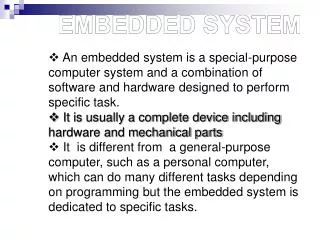
What is Embedded • From Wikipedia: “An embedded system is a computer system with a dedicated function within a larger mechanical or electrical system, often with real-time computing constraints.”
Examples • Arduino • Raspberry Pi • PLC • Automotive Computers
Arduino Vs TinyOS • TinyOS is a full fledged operating system • TinyOS and APIs are designed for low power applications • Arduino focuses on I/O • TinyOS focuses on wireless networking
Hardware MicaZ IRIS
Hardware (cont.) NXTMOTE TelsoB
Software • Stack • Split-phase • APIs • nesC
Stack • One Stack • Singular • Longer Life Span
Split-phase • First phase: • Start • Second phase: • Callback
APIs • Rigorously tested • All split-phase • Bidirectional
nesC • Dialect of C • Explicitly define interfaces • Bidirectional • Requires two files • Configuration • Module
nesC - Configuration • Defines interfaces • Used • Provided • Is used to generate executed
nesC - Module • Lists interfaces • Provides implementation • Major Operation • APIs
Conclusion • TinyOS is used for • Wireless embedded projects • Has APIs • Non-blocking • Bidirectional