
Learning Objectives
E N D
Presentation Transcript
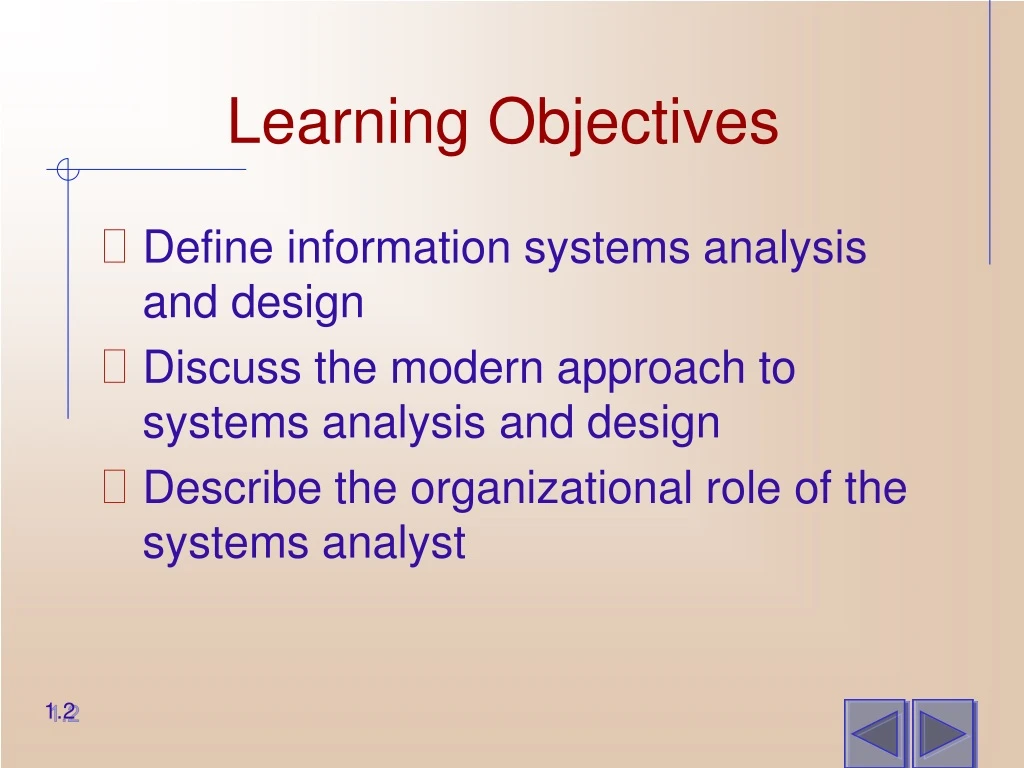
Learning Objectives • Define information systems analysis and design • Discuss the modern approach to systems analysis and design • Describe the organizational role of the systems analyst 1.2
Learning Objectives • Describe four types of information systems: • Transaction Processing Systems (TPS) • Management Information Systems (MIS) • Decision Support Systems (DSS) • Expert Systems (ES) • Describe the information systems development life cycle (SDLC) 1.3
Learning Objectives • Discuss alternatives to the systems development life cycle • Discuss the role of computer aided software engineering (CASE) tools in systems development 1.4
Chapter Preview • Systems Analysis is a proven method to help business utilize information to its fullest • Systems Development Life Cycle (SDLC) • Central to Information Systems Development 1.5
Information Systems Analysis and Design • A method used by companies to create and maintain systems that perform basic business functions • Main goal is to improve employee efficiency by applying software solutions to key business tasks • A structured approach must be used in order to ensure success 1.7
Information Systems Analysis and Design • Systems Analyst performs analysis and design based upon: • Understanding of organization’s objectives, structure and processes • Knowledge of how to exploit information technology for advantage • Fig 1-1 illustrates the Systems Development Life Cycle, a four-phased approach used throughout this text 1.8
Systems Analysis and Design: Core Concepts • Major goal: to improve organizational systems by developing or acquiring software and training employees in its use • Application software, or a system, supports organizational functions or processes 1.9
Systems Analysis and Design: Core Concepts • System: Turns data into information and includes: • Hardware and system software • Documentation and training materials • Job roles associated with the system • Controls to prevent theft or fraud • The people who use the software to perform their jobs • Figure 1-2 illustrates all the components of a system 1.10
Software Engineering Process • A process used to create an information system • Consists of: • Methodologies • A sequence of step-by-step approaches that help develop the information system • Techniques • Processes that the analyst follows to ensure thorough, complete and comprehensive analysis and design • Tools • Computer programs that aid in applying techniques 1.11
System • A system is an interrelated set of business procedures used within one business unit working together for a purpose • A system has nine characteristics • A system exists within an environment • A boundary separates a system from its environment 1.12
Characteristics of a System • Components • Interrelated Components • Boundary • Purpose • Environment • Interfaces • Constraints • Input • Output 1.13
Important System Concepts • Decomposition • The process of breaking down a system into smaller components • Allows the systems analyst to: • Break a system into small, manageable subsystems • Focus on one area at a time • Concentrate on component pertinent to one group of users • Build different components at independent times 1.14
Important System Concepts • Modularity • Process of dividing a system into modules of a relatively uniform size • Modules simplify system design • Coupling • Subsystems that are dependent upon each other are coupled • Cohesion • Extent to which a subsystem performs a single function 1.13
A Modern Approach to Systems Analysis and Design • Systems Integration • Allows hardware and software from different vendors to work together. • Enables procedural language systems to work with visual programming systems • Visual programming environment uses client/server model 1.14
Data and Processes • Three key components of an information system • Data • Data Flows • Processing Logic • Data vs. Information • Data • Raw facts • Information • Derived from data • Organized in a manner that humans can understand. 1.15
Data and Processes • Data • Understanding the source and use of data is key to good system design • Various techniques are used to describe data and the relationship amongst data • Data Flows • Groups of data that move and flow through the system 1.16
Data and Processes • Data Flows (Continued) • Include description of sources and destination for each data flow • Processing Logic • Describe steps that transform data and events that trigger the steps 1.17
Approaches to Systems Development • Process-Oriented Approach • Focus is on flow, use and transformation of data in an information system • Involves creating graphical representations such as data flow diagrams and charts • Data are tracked from sources, through intermediate steps and to final destinations • Natural structure of data is not specified • Disadvantage: data files are tied to specific applications 1.18
Approaches to Systems Development • Data-Oriented Approach • Depicts ideal organization of data, independent of where and how data are used • Data model describes kinds of data and business relationships among the data • Business rules depict how organization captures and processes the data 1.19
Databases and Application Independence • Database • Shared collection of logically related data • Organized to facilitate capture, storage and retrieval by multiple users • Centrally managed • Designed around subjects • Customers • Suppliers • Application Independence • Separation of data and definition of data from applications 1.20
Role of the Systems Analyst • Study problems and needs of an organization • Determine best approach to improving organization through use of: • People • Methods • Information technology • Help system users and managers define their requirements for new or enhanced systems 1.21
Role of the Systems Analyst • Assess options for system implementation • In-house development • Outsourced development • Outsourced development and operation • Commercial application • For in-house projects, work on a team of analysts and developers 1.22
Skills of a Successful Systems Analyst • Analytical • Understanding of organizations. • Problem solving skills • System thinking • Ability to see organizations and information systems as systems • Technical • Understanding of potential and limitations of technology. 1.23
Skills of a Successful Systems Analyst • Managerial • Ability to manage projects, resources, risk and change • Interpersonal • Effective written and oral communication skills 1.24
Types of Information Systemsand Systems Development • Transaction Processing Systems (TPS) • Automate handling of data about business activities (transactions) • Management Information Systems (MIS) • Converts raw data from transaction processing system into meaningful form • Decision Support Systems (DSS) • Designed to help decision makers • Provides interactive environment for decision making 1.25
Types of Information Systemsand Systems Development • Expert Systems (ES) • Replicates decision making process • Knowledge representation describes the way an expert would approach the problem 1.26
Systems Development Life Cycle • System Development Methodology • Standard process followed in an organization • Consists of: • Analysis • Design • Implementation • Maintenance 1.27
Systems Development Life Cycle • Series of steps used to manage the phases of development for an information system • Consists of four phases: • Planning and Selection • Analysis • Design • Implementation and Operation 1.28
Systems Development Life Cycle • Phases are not necessarily sequential • Each phase has a specific outcome and deliverable • Individual companies use customized life cycle 1.29
Phases of the Systems Development Life Cycle • Systems Planning and Selection • Two Main Activities • Identification of need • Investigation and determination of scope • Systems Analysis • Study of current procedures and information systems • Determine requirements • Generate alternative designs • Compare alternatives • Recommend best alternative 1.30
Systems Development Life Cycle • System Design • Logical Design • Concentrates on business aspects of the system • Physical Design • Technical specifications • Implementation and Operation • Implementation • Hardware and software installation • Programming • User Training • Documentation 1.31
Systems Development Life Cycle • Operation • System changed to reflect changing conditions. • System obsolescence 1.32
Approaches to Development • Prototyping • Building a scaled-down working version of the system • Advantages: • Users are involved in design • Captures requirements in concrete form • Rapid Application Development (RAD) • Utilizes prototyping to delay producing system design until after user requirements are clear 1.33
Approaches to Development • Joint Application Design (JAD) • Users, Managers and Analysts work together for several days • System requirements are reviewed • Structured meetings 1.34
Summary • Information systems analysis and design • Process of developing and maintaining an information system • Modern approach to systems analysis • Process-Oriented • Data-Oriented 1.35
Summary • Role of Systems Analyst • Four types of information systems • Transaction Processing (TPS) • MIS • Decision Support (DSS) • Expert Systems (ES) 1.36
Summary • Systems Development Life Cycle (SDLC) • Systems Planning and Selection • Systems Analysis • Systems Design • Systems Implementation • Alternatives to Systems Development Life Cycle • Prototyping • Rapid Application Development (RAD) • Joint Application Design (JAD) 1.37