Clinical assessment
This document outlines the critical components of clinical assessment for stroke identification, including differentiating between hemorrhagic and ischemic events. It details the localization of cerebral lesions based on neurological signs and symptoms, supported by imaging techniques like CT and MRI. Emphasis is placed on understanding brain anatomy and functions, potential symptoms tied to specific lesions, and evaluating patient problems for effective treatment options. This guide aims to enhance clinical decision-making in stroke management and prevention of subsequent strokes.

Clinical assessment
E N D
Presentation Transcript
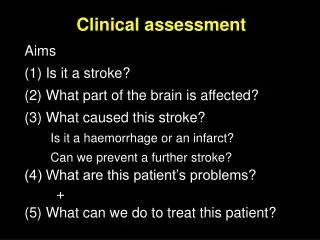
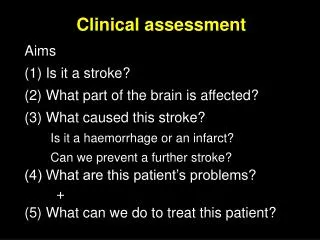
Clinical assessment Aims (1) Is it a stroke? (2) What part of the brain is affected? (3) What caused this stroke? Is it a haemorrhage or an infarct? Can we prevent a further stroke? (4) What are this patient’s problems? + (5) What can we do to treat this patient?
Localising the lesion • Establish what symptoms the patient had • Identify their neurological signs • Sometimes confirm with an image (CT or MRI scan)
Localisation depends on Neuroanatomy Cerebral hemispheres Midbrain Cerebellar hemispheres Brainstem including PONS & Medulla Spinal cord
Localisation of functions Motor Sensory Right parietal Neglect Left parietal Language Visual Cerebellum Coordination Brainstem
A small stroke there (or there) will result in a major deficit as the fibres are packed close together Deep white matter - the connecting fibres
Symptoms and Signs of a brainstem lesion Symptoms Double vision Spinning vertigo Bilateral weakness Hiccups Signs Eye movements Nystagmus Horners syndrome Ataxia Bilateral signs
Motor fibres cross in medulla Cortex Internal capsule Medulla A left hemisphere or left brainstem lesion will cause right sided weakness Spinal cord Peripheral nerve Lower motor neurone
Sensory fibre cross in spinal cord (pain & temp) or in medulla (JPS & vibration) A left hemisphere lesion will cause loss of sensation on right side Dissociated sensory loss i.e. loss of pain & temp but not JPS & vibration or visa versa brainstem or cord
Cerebellar fibres do not cross Left cerebellar hemisphere lesion causes ataxia of left limbs Midline cerebellar lesion causes truncal ataxia
Visual Pathways L R Eyes Optic nerves Optic chiasma Optic radiation Visual cortex Right Field Left Field
Where is the lesion? • Patient has • Right arm weakness • Right facial weakness • Dysphasia
Localisation of functions Motor Sensory Right parietal Neglect Left parietal Language Visual Cerebellum Coordination Brainstem
Motor fibres cross in medulla Cortex Internal capsule Medulla A left hemisphere or left brainstem lesion will cause right sided weakness Spinal cord Peripheral nerve Lower motor neurone
Where is the lesion? • Complete paralysis of right side • (face, arm & leg) • Dysphasia • Loss of right visual field
Visual Pathways L R Eyes Optic nerves Optic chiasma Optic radiation Visual cortex Right Field Left Field
Where is the stroke? • Loss of all sensation in right face, arm and leg • Mild weakness of right arm and leg
Sensory fibre cross in spinal cord (pain & temp) or in medulla (JPS & vibration) A left hemisphere lesion will cause loss of sensation on right side Dissociated sensory loss i.e. loss of pain & temp but not JPS & vibration or visa versa brainstem or cord
Where is the lesion? • Patient started with • truncal ataxia • headache and vomiting • He is now becoming drowsy
Cerebellar fibres do not cross Left cerebellar hemisphere lesion causes ataxia of left limbs Midline cerebellar lesion causes truncal ataxia
Where is the lesion? • Patient complains of • problems reading • O/E • right visual field defect • (homonymous hemianopia)
Visual Pathways L R Eyes Optic nerves Optic chiasma Optic radiation Visual cortex Right Field Left Field
Where is the lesion? Sudden onset left leg weakness O/E: • unaware of problems • dense weakness of left, loss of sensation • doesn’t look to left
Where is the lesion? • nystagmus in all directions • ataxia of left arm & leg
Where is the lesion? • Right arm & leg weakness • No field defect • Language OK • Not drowsy
Clinical assessment Aims (1) Is it a stroke? (2) What part of the brain is affected? (3) What caused this stroke? Is it a haemorrhage or an infarct? Can we prevent a further stroke? (4) What are this patient’s problems? + (5) What can we do to treat this patient?