Understanding Motion: Speed, Average Speed, and Velocity Explained
Explore the concepts of motion, speed, average speed, and velocity in this comprehensive guide. Motion refers to the change in position of an object over time relative to a reference point. Speed is defined as the rate at which an object moves, while average speed calculates the distance traveled over a specified time. Learn how to determine average speed through examples such as walking a distance or calculating travel time for vehicles. Discover the importance of velocity, which includes direction in its definition.

Understanding Motion: Speed, Average Speed, and Velocity Explained
E N D
Presentation Transcript
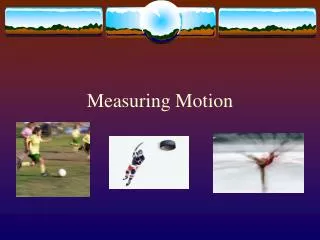
What is Motion? • Motion is when an object changes position over time when compared with a reference point.
What is Speed? • Speed is the rate at which and object moves.
Determining Average Speed • Average speed is the amount of speed traveled in a given period of time. • Average Speed = Total distance Total time
Calculate the Average Speed • Q. If you take a walk for 1.5 hours and travel 7.5 km, what is your average speed? • Average Speed = Total distance Total time A. Average Speed = 7.5 km = 5km/hrs 1.5 hrs
Calculate the Average Speed • Q. If the average speed of a car is 110 km/hr, how long will it take the car to travel 715 km? • Average Speed = Total distance Total time • A. 110 km/hr = 715 km x Step 1. (110 km/hr)(x)= 715 km Step 2. (110 km/hr)(x) = (715 km) (110 km/hr) (110 km/hr) Step 3. x = 715 = 6.5 hrs 110 hr
What is Velocity? • Velocity is the speed of an object in a particular DIRECTION. • Velocity changes as speed or direction changes. • Ex. 15m/s East • Ex. 28m/s North