Interaction of Amino Acids with Cathode and Anode in Electrophoresis
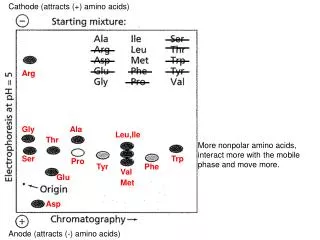
This study examines the behavior of various amino acids under electrophoretic conditions, specifically how cathodes attract positively charged amino acids like Arginine (Arg), Glycine (Gly), and Alanine (Ala), while anodes attract negatively charged amino acids such as Aspartic acid (Asp) and Glutamic acid (Glu). The research highlights that nonpolar amino acids like Leucine (Leu) and Isoleucine (Ile) interact more with the mobile phase, enhancing their mobility in electrophoresis. Understanding these interactions is crucial for optimizing separation techniques in biochemical applications.

Interaction of Amino Acids with Cathode and Anode in Electrophoresis
E N D
Presentation Transcript
Cathode (attracts (+) amino acids) Arg Gly Ala Leu,Ile Thr More nonpolar amino acids, interact more with the mobile phase and move more. Ser Trp Pro Tyr Phe Val Glu Met Asp Anode (attracts (-) amino acids)
Cathode (attracts (+) amino acids) Arg * As per solutions manual Gly Ala Val Leu,Ile Thr More nonpolar amino acids, interact more with the mobile phase and move more. Ser Pro Tyr Phe Trp Glu Met Asp Anode (attracts (-) amino acids)