Thermodynamics
Thermodynamics is the study of energy changes during physical and chemical processes, focusing on heat transfer. Key concepts include exothermic and endothermic reactions, specific heat, calorimetry, and the laws of thermodynamics. Heat flows from warmer to cooler objects, and specific heat measures energy needed to change a substance's temperature. The first law emphasizes energy conservation, while enthalpy defines heat in reactions. Additionally, entropy, spontaneous changes, and their spontaneity conditions play vital roles. Explore these fundamentals to grasp how energy dynamics impact matter.

Thermodynamics
E N D
Presentation Transcript
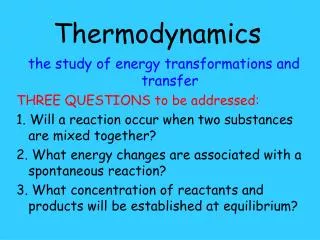
Measuring Heat • Thermodynamics = the study of changes in energy that accompany chemical or physical changes • Exothermic • Endothermic • When water freezes • When ice melts
Heat Transfer • Heat = a form of energy • Symbol = q • Always flows from a warmer object to a cooler object • Temperature – measure of average kinetic energy
Specific Heat • Amount of heat needed to raise the temperature of 1 g of a substance by 1 oC • Symbol = C • Unit = J/g oC • High specific heat = absorbs a lot of energy w/small changes in temperature
Calorimetry • Measurement of heat transfer • q = (m)(C)( T) • (+)q = heat absorbed • (-)q = heat released • Actual amount of energy transferred is never a negative number
What amount of heat is needed to increase the temperature of 10.00 mol of mercury by 7.50 oC? (CHg = 0.139 J/goC)
1st law of thermodynamics • In any physical or chemical process, energy is neither created or destroyed • Energy is not lost or gained, just transferred
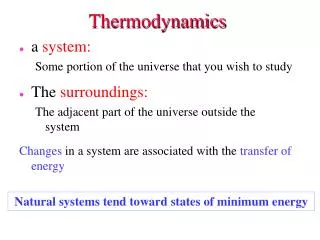
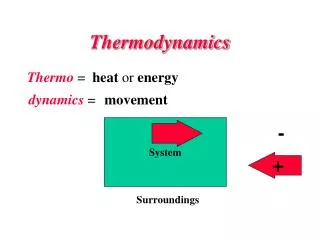
System • Specific part of the universe on which you focus your attention (reactants!) • When heat transferred from one substance to another they are both part of the system • Heat absorbed by substance 1 = heat lost by substance 2 • The 2 substances will continue to absorb/lose heat until they are the same temperature
q1 = -q2 • (m1)(C1)( T1) = - (m2)(C2)( T2)
Steps for solving problems • List all known variables • Solve for q1 • Plug in opposite of q1 for q2 and solve for variable
A 118 g piece of tin at 85 oC is dropped into 100 g of water at 35 oC. The final temperature of the mixture is 38 oC. C of water is 4.18 J/goC. What amount of heat is absorbed by the water? What amount is released by the tin? What is the specific heat of tin?
A 125 g sample of iron at 93.5 oC is dropped into an unknown mass of water at 25.0 oC. The final temperature of the mixture is 32.0 oC. The C of iron is 0.451 J/goC, the C of water is 4.18 J/goC. What is the mass of the water?
Enthalpy and Heat of Reaction • Enthalpy = amount of heat a sample has at a certain pressure and temperature • Only changes in enthalpy can be measured • Symbol = H
At the start of a reaction, each reactant has its own enthalpy • As reaction progresses heat is either released or absorbed • Change = heat of reaction, Hrxn • Hrxn = H of products – H of reactants
Exothermic or Endothermic? • Hrxn is positive • Hrxn is negative
Enthalpy and Heat of Formation • Heat of formation = enthalpy change when 1 mol of a compound is formed from its elements. • Hf
For any chemical reaction, enthalpy change uses the equation • Hrxn = (sum of Hfof products) – (sum of Hf of reactants) • Hf of an element = 0
Find the Hrxn for the following balanced equation: 2Fe + 3CO2(g) Fe2O3(s) + 3CO(g)
Find the Hrxn for the following balanced equation: 4NH3(g) + 7O2(g) 4NO2(g) + 6H2O(g)
Phase Change Diagram Csteam = 1.70 J/goC Liquid steam: 40.7 kJ/mol CWater = 4.18 J/goC solid liquid: 6.01 kJ/mol Cice= 2.10 J/goC
The heat absorbed by one mole of a substance in melting from a solid to a liquid at a constant temperature is the molar heat of fusion
How much heat is gained when 57.6 g of ice is melted completely? H2O (s) H2O (l)
How much heat is released when 50.0 g of steam cools to 40oC?
Challenge!!! • A 39.0g sample of ice at -125 oC changes into steam at 125 oC. How much energy is absorbed during this process?
Entropy • Changes tend to occur so the lowest possible energy of a system is reached • A system at a state of low energy is more stable than a system at a state of high energy • Entropy = measure of the disorder or randomness of a system
What has more entropy? • Ice or liquid water? • Liquid water or steam?
2nd law of thermodynamics • Entropy of the universe is always increasing • Systems tend to move toward lower energy, they also tend to move toward higher entropy
3rd law of thermodynamics • Entropy of an ideal solid at 0 K is zero
Changes that result in increased entropy • Solid liquid (or part of a solution) • Liquid gas • Temperature increase • In reactions, when the number of particles increases • CaCO3 CaO + CO2
Spontaneity • Spontaneous changes occur naturally • Ice melting • Rust forming: 4Fe + 3O2 2Fe2O3 • Nonspontaneous changes do not occur without the addition of energy • Rust decomposing: 2Fe2O3 4Fe + 3O2
Determining Spontaneity • Enthalpy change – exothermic more likely spontaneous than endothermic • Entropy change – change that results in more entropy more likely spontaneous than change in which entropy decreases • Temperature – determines spontaneity when the first two don’t
Change that is exothermic & results in increased entropy = always spontaneous • C3H8 + 5O2 3CO2 + 4H20 • Moles of reactants and products? • What does this mean? • Hrxn = -2220000 J/mol • What does this mean?
Exothermic changes that have decreased entropy are sometimes spontaneous • Determining factor = temperature • If temp is low enough change is spontaneous • H20 (g) H2O (l) • H rxn = -40.7 kJ/mol • Entropy increase or decrease? • Temp @ which reaction spontaneous?
Endothermic change that increases entropy is sometimes spontaneous • If temperature is high enough reaction is spontaneous • H2O (s) H2O (l) • H rxn = 6.01 kJ/mol • Entropy increase or decrease? • Temp @ which reaction is spontaneous?
Endothermic changes with decreased entropy will NEVER be spontaneous
N2 + 3H2 2NH3 Hrxn = -46 kJ/mol • Exothermic or endothermic? • Entropy increase or decrease? • Spontaneous?
Review Problem 1 • A 225 g sample of iron at 98.5 oC is placed into 72.4 g of water at 22.0 oC. The final temperature of the mixture is 41.2 oC. The specific heat of water is 4.18 J/g oC, what is the specific heat of iron?
Review problem 2 • What is the Hrxn for the reaction: • P4(s) + 6H2O(l) 4H3PO4(l)
Review problem 3 • What amount of heat is released when 252 g of tin at 112 oC cools to 37.5 oC. The specific heat of tin is 0.226 J/g oC
Review problem 4 • How much energy is released when 57 g of steam condenses to liquid water? The heat of vaporization of water is 40.7 kJ/mol.
Specific heat • Thermodynamics • 1st, 2nd, 3rd law of thermodynamics • Entropy • Heat • Temperature • Endo/exothermic (- or +)