Understanding Acid-Base Equilibria: Definitions, Properties, and Calculations
This chapter delves into acid-base equilibria, defining acids and bases through Arrhenius and Bronsted-Lowry theories. Acids release H+ ions, while bases release OH- ions in solution. Strong acids and bases ionize completely, whereas weak acids and bases only partially ionize. The relationship between hydrogen and hydroxide ion concentrations, pH, and pOH is emphasized, with relevant formulas provided. Concepts like acid dissociation constant (Ka) and equilibrium principles are covered, along with problem-solving techniques for various acid-base scenarios.

Understanding Acid-Base Equilibria: Definitions, Properties, and Calculations
E N D
Presentation Transcript
CHEMISTRY Chapter 15Acid-Base Equilibria
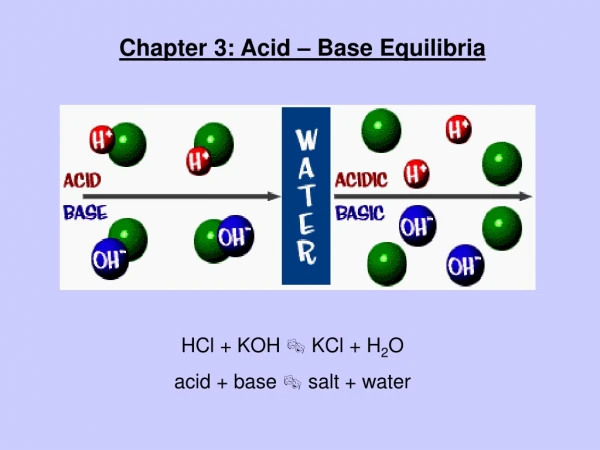
Acids and Bases • Arrhenius’ Definition: • Acids - are substances that produce hydrogen ions (protons or H+) in solution. Bases - are substances that produce hydroxide ions in solution. Strong Acids and Strong Bases – totally ionize in solution Weak Acids and Weak Bases – partially ionize in solution
Acid Dissociation in Water • General Rxn. when Acid dissolves in H2O • HCl + H2O H3O+ + Cl- acid base conj. Acid conj. base
Properties of H2O @ 25 oC • H2O (l) DH+ (aq) + OH- (aq) • Neutral, can act as an acid and a base • Kw = [H+][OH-] = 1.0 x 10⁻¹⁴only @ 25 oC • Kw = water dissociation constant
Acidity vs. Basicity • If [H+] >[OH-] , solution is acidic • If [H+] <[OH-] , solution is basic • The term pX = -log [concentration of X] • So: pH = -log [concentration of H+] • pOH = -log [concentration of OH-] • pH = power of hydrogen; the power of H to which 10 is raised
pH • Kw = [H+][OH-] = 1.0 x 10⁻¹⁴ @ 25 oC • pKw = [-log H+] + [-log OH-]= - [log 1.0 x 10⁻¹⁴] = 14 • pH = -log [H+] • pOH = -log [OH-]
Properties of H2O @ 25 oC • pKw = - [log 1.0 x 10⁻¹⁴] = 14 • pH + pOH = 14 • pH = 7 pOH = 7 • pH = pOH
Things to Remember • pKw = - [log 1.0 x 10⁻¹⁴] = 14 @ 25 oC • pH + pOH = 14 • pH <7 ; acidic • pH > 7; basic • pH is between 0 - 14
Broensted-Lowry’s Definition • Acid – is a proton (H+) donor. • Base – is a proton (H+) acceptor. • * Broensted-Lowry Definition is more general • It even applies to bases that have no –OH such as NH3.
Terminologies • H+ = proton • OH- = hydroxide ion • H3O+ = hydronium ion • Conjugate base –acid minus proton • Conjugate acid – base plus proton
More Terminologies • Conjugate acid-base pair • Consists of 2 substances related to each other by the donation and acceptance of a single proton (H+). • Acid Dissociation Constant (Ka)
Equations • pH = - log [H+] • pOH = - log [OH-] • [H+] = 10 – pH • [OH-] = 10 - pOH • Kw = 10 - pKw • pKw = pH + pOH • pKw = - log [Kw] • Pw = [H+][OH-]
Sample Problem • At 40 oC, a solution has Kw = 2.916 x 10⁻¹⁴; pH = 7.51 • Calculate the following: • A. pOH of the solution • B. hydrogen ion concentration [H+] • C. hydroxide ion concentration [OH-] • D. pKw • E. Is the solution acidic basic or neutral?
Equilibrium • K = [H3O+ ][Cl- ] = [H+][Cl-] [HCl][H2O] [HCl] • H2O removed from top and bottom since H3O+ is simply H+ dissolved in water. • Remember: Keq = [products] [reactants]
Acid Strength • Strength of acid is given by the equilibrium position of the dissociation reaction: • HA (aq) + H2O (l) H3O+ + A- • Strong acid – totally ionized and equilibrium lies far to the right • Weak acid – only partially ionized and equilibrium lies far to the left
Strong Acid vs. Weak Acid • Strong Acid – yields a weak conjugate base (one that has weak affinity for proton; weaker than H2O) • Weak Acid – yields a strong conjugate base (one that has strong affinity for proton; stronger than H2O)
Please Note! • Tuesday’s experiment is Experiment 29: Choice I.
Sample Problems • Given [OH-] = 1.0 x 10⁻¹² M, calculate pH. Is the solution basic, acidic or neutral? • Given [H+] = 4.30 x 10⁻⁶ M, calculate pH. Is the solution basic, acidic or neutral?
Strong Acids and Bases • If the molarity of the acid or base is less than 10-6M then the autoionization of water needs to be taken into account. In other words, water is the primary source of H+ and OH-, so the pH would be neutral.
Strong Acids and Bases • Strong Acids • The strongest common acids are HCl, HBr, HI, HNO3, HClO3, HClO4, and H2SO4. • are strong electrolytes. • All strong acids ionize completely in solution:
Strong Acids and Bases • If the molarity of the acid or base is less than 10-6M then the autoionization of water needs to be taken into account. In other words, water is the primary source of H+ and OH-, so the pH would be neutral.
pH of Strong Acids and Bases • The pH (and hence pOH) of a strong acid is given by the initial molarity of the acid. • The pOH (and hence pH) of a strong base is given by the initial molarity of the base. • Be careful of stoichiometric ratios!
Please Note! • Tuesday’s experiment is Experiment 29: Choice I.
Bronsted-Lowry Acids and Bases • Bronsted-Lowry acids – compounds that donate a proton (H+) • Bronsted-Lowry Bases – compounds that accept a proton (H+) • Note that Bronsted-Lowry bases need not have the –OH group on the formula
Weak Acids • Weak acids are only partially ionized in solution. • There is a mixture of ions and unionized acid in solution. • Therefore, weak acids are in equilibrium:
NOTE • For Weak Acids and Weak Bases: • USE ICE to determine H+, OH-, pH and pOH.!
Sample A Problem • A solution of 0.10 M formic acid (HCOOH) has a pH of 2.38 at 25 oC. • A. Calculate Ka for formic acid at this temperature. • B. What percent of this solution is ionized?
Sample Problem • The Ka of acetic acid is 1.8 x 10⁻⁵. • A. Calculate the pH of a 0.30 M solution of CH3COOH. • B. Calculate OH- and pOH. • C. Calculate Kb. • Calculate % ionization.
A Simple Trick • Use of approximation: eliminates the difficulty of quadratic equations. • Approximation is Valid if: X_______ x 100 < 5 % [Initial Concn.]
Relationship between Ka and Kb • Ka x Kb = 1.0 x 10 -14only at 25 oC.
pH of polyprotic acids • Treat polyprotic acids as separate steps! • #1. H2A (aq) D H+ (aq) + HA- (aq) Ka1 • # 2. HA- (aq) D H+ (aq) + A-2 (aq) Ka2 • Initial [H+] in Step 2 is Equil. [H+] from Step 1. • Total [H+] = SUM from Steps 1 & 2
HOMEWORK • What is the pH of a 1.00 M solution of tartaric acid, H2C4H4O6 (aq.) at 25.0 oC? • Answer: pH = 1.49
Sample Problem • The Ka of acetic acid is 1.8 x 10⁻⁵. Calculate the Kb of of CH3COOH.
Sample Problem • The Ka of ammonia is 1.8 x 10⁻⁵. Calculate the pH of a 0.15 M solution of NH3.
Sample Problem • Calculate the concentration of an aqueous solution of NaOH that has a pH of 11.50.
HOMEWORK • What is the pH of a 1.00 M solution of tartaric acid, H2C4H4O6 (aq.) at 25.0 oC? • Answer: pH = 1.49
Weak Acids • Calculating Ka from pH • Weak acids are simply equilibrium calculations. • The pH gives the equilibrium concentration of H+. • Using Ka, the concentration of H+ (and hence the pH) can be calculated. • Write the balanced chemical equation clearly showing the equilibrium. • Write the equilibrium expression. Find the value for Ka. • Write down the initial and equilibrium concentrations for everything except pure water. We usually assume that the change in concentration of H+ is x.
Weak Acids • Calculating Ka from pH • Substitute into the equilibrium constant expression and solve. Remember to turn x into pH if necessary. • Using Ka to Calculate pH • Percent ionization is another method to assess acid strength. • For the reaction
Sample Problem • A solution of NH3 in water has a pH of 10.50. What is the initial molarity of the solution?
Other Weak Bases • Amines ex. Methylamine (CH3NH2) • carbonate ion (CO32-) • hypochlorite ion (ClO-1)
Weak Bases • Also use ICE! • Calculation is the same as for weak acids! • Main difference is that you get [OH-] and pOH first.
Effects of Salts on pH • Conjugate bases of strong acids have no effect on pH. • Conjugate acids of strong bases have no effect on pH. • Conjugate bases of weak acids increase pH (more basic). • Ex. F- (aq) + H2O(l) D HF (aq) + OH- (aq) • Conjugate acids of weak bases decrease pH (more acidic). • NH4+(aq) + H2O (l) D NH3 (aq) + H3O+ (aq)
Acid-Base Properties of Salt Solutions • Combined Effect of Cation and Anion in Solution • A cation that is the conjugate acid of a weak base will cause a decrease in the pH of the solution. • Metal ions will cause a decrease in pH except for the alkali metals (Grp. I) and alkaline earth metals.(Grp.II) • When a solution contains both cations and anions from weak acids and bases, use Ka and Kb to determine the final pH of the solution.
Sample Problem • Determine whether the resulting solution in water will be acidic, basic or neutral. • A. K+ClO3- • B. Na+CH3COO- • C. Na2HPO4 Ka for HPO4- = 4.2 x 10⁻¹³ • D. NH4+Cl-
Sample Problem • Predict whether the potassium salt of citric acid (K2+HC6H5O7-) will form an acidic, basic or neutral solution in water.
Weak Acids • Polyprotic Acids • Polyprotic acids have more than one ionizable proton. • The protons are removed in steps not all at once: • It is always easier to remove the first proton in a polyprotic acid than the second. • Therefore, Ka1 > Ka2 > Ka3 etc.
Weak Acids Polyprotic Acids