IMMUNISATIONS
This document provides essential information on various vaccinations, including Measles, Mumps, Rubella (MMR), Diphtheria, Tetanus, and Pertussis (DTaP), as well as Pneumococcal and Meningococcal vaccines. It covers the characteristics of viral and bacterial infections, their transmission, incubation periods, complications, and the importance of routine immunizations in preventing outbreaks. It also discusses contraindications for vaccination and emergency procedures for anaphylaxis. Public health initiatives, including catch-up programs for incomplete immunizations, are highlighted to emphasize the importance of immunization for community health.

IMMUNISATIONS
E N D
Presentation Transcript
IMMUNISATIONS Janet Anderson courtesy of Pamela Lewis
MEASLES • Viral, droplet spread, incubation 10 days • Coryza, conjunctivitis, fever, rash • Complications, pneumonia,encephalitis,death • Notifiable • Catch up programme offered to those with incomplete immunization because of increasing notifications
MUMPS • Viral,droplet spread, incubation 14-21 days • Parotid swelling • Complications oophritis,orchitis,pancreatitis,and meningitis • Notifiable
RUBELLA • Viral, droplet spread incubation 14-21 days • Mild illness with rash and lymphadenopathy • Maternal rubella, 1st trimester 90% foetal damage ( microcephaly, deafness, cataracts, PDA etc) • History needs confirmation with saliva or serology
DIPHTHERIA • Corynebacteria diphtheriae • Incubation 2-5 days Infectious for four weeks • Inflammatory exudate causing grey membrane in resp tract. Potential obstruction • Toxin mediated damage to myocardium, nervous system and adrenals
TETANUS • Toxin mediated from tetanus bacillus • Incubation 4-21 days • Spore spread • Muscular rigidity with spasms ---(lock jaw)
POLIO • Polio virus • Faecal/oral spread, Incubation 3-21 days • Virus may be shed for 6 weeks • Range of severity asymptomatic to paralysis
PERTUSSIS • Bordetella pertussis • Incubation 7-10 days • Infectious until 3 weeks after onset of paroxysms • Paroxysmal cough can be associated with apnoea and /or vomiting • Complications--- SIDS, bronchopneumonia and cerebral hypoxia
HAEMOPHILUS INFLUENZAEType B • Hib • Meningitis with high incidence of complications +/- bacteraemia • Epiglottitis • Osteomyelitis
MENINGOCOCCAL DISEASE • Neisseria meningitidis • Type C vaccine, Type B no vaccine---(also available Type A for travelers) • Incubation 2-3 days • Onset can be fulminant • Meningitis / septicaemia • Fever, vomiting, purpuric rash
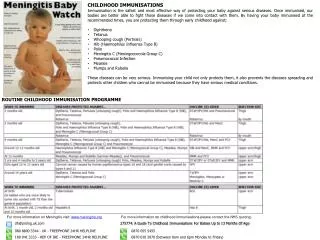
Routine Immunisations • 2 months Diphtheria Pertussis Tetanus Hib Polio Pneumococcal (PCV) • 3 months Diphtheria Pertussis Tetanus Hib Polio Men C • 4 months Diphtheria Pertussis Tetanus Hib Polio Pneumococcal MenC
Immunisations • 12 months Men C and Hib • 13 months MMR and Pneumococcal • 3 to 5 yrs Diptheria Pertussis Tetanus Polio MMR • 15 yrs Diptheria Tetanus Polio
Active Immunity • Live Attenuated Vaccines eg BCG, MMR, yellow fever, oral polio • Inactivated Vaccines eg influenza • Extracts of or Detoxified Endotoxins eg tetanus
Passive Immunity • Normal Immunoglobulin eg for replacement therapy of agammaglobulinaemia • Specific Immunoglobulin eg tetanus, VZV rabies, HepB and palivizumab for RSV protection
Contraindications To Vaccination • General – Febrile illness • Anaphylaxis to previous dose or to components of vaccine • Severe local reaction • Inconsolable unexplained crying >3 hrs within 72hrs • Encephalopathic illness (hypotonic-hyporesponsive episode (HHE)) within 72 hours • Live Vaccines – Immunosuppressed, eg prednisolone therapy, chemotherapy, HIV (note MMR), BMT within 6 month. Pregnancy
DTaP/IPV/Hib and MenC • Diptheria, Tetanus, acellular pertussis, Inactivated polio , Haemophilus influenzae and Meningitis C • New changes are inactivated polio (im) and acellular pertussis • Well tolerated, minimal side effects
MMR • Measles, Mumps and Rubella • Serious illnesses associated with significant mortality • Fever common 6 to 10 days post vaccination • 1:1000 febrile convulsion • Can be given to egg allergic children • NOT associated with Autism and IBD
BCG • Administered to at risk babies in neonatal period • Since 2006 risk-based programme for other children as well • Local Side effects common • Do not give to HIV + or immunocompromised Mantoux induration > 6mm Previous BCG or past/ present TB.
PNEUMOCOCCAL VACCINES • Pneumovax > 2years 23- valent polysac • Prevenar < 2yrs 7- valent • Indications for those not previously immunised ---asplenia, SS, Chronic lung or heart disease
OTHERS • RSV - passive immunisation—Synargis –given during RSV season to high risk groups • HBV – at risk groups (at present) • HPV – Human Papilloma Virus vaccine Given to 12-13 year old –due to increase coverage to 17-18 year olds in September 2008 Protects against 70% of cervical cancers
ANAPHYLAXIS • ABC • Adrenaline 10 mcg/Kg (0.01ml/Kg 1:1000) • Hydrocortisone 4mg/Kg • Chlorphenamine