Optimizing Sound Absorption of Plane Wave in Air Cavity with Various Thicknesses
140 likes | 257 Vues
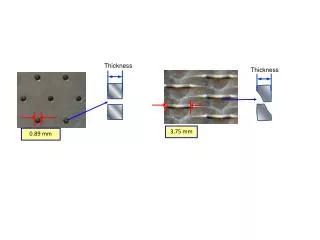
This study explores the impact of thickness variations (0.89 mm-3.75 mm) on the absorption of plane waves in air cavities. The testing method involves measuring parameters such as pressure (p1, p2), volume (v1, v2), and temperature (t). Results indicate that above 1800 Hz, measurements are not valid due to the chosen material properties (MPP). When MPP is placed on top of backing (l1, d1, l2, d2), it enhances sound absorption. The placement of MPP on backing affects spacings (S1, S2) and can be optimized at 2, 4, or 8-inch intervals. The design features small porosity using expanded metal for superior sound absorption in source rooms and partitions.


Optimizing Sound Absorption of Plane Wave in Air Cavity with Various Thicknesses
E N D
Presentation Transcript
Thickness Thickness 0.89 mm 3.75 mm
1 2 3 d Plane Wave Air Cavity p2 v2 p1 v1 t D
1 2 Plane Wave … n
0.5 in. 2 in. 4 in. Measurement not valid above 1800 Hz
MPP s s s d1 d2 d3 d4 MPP is laid on top of backing. l a. b.
MPP MPP MPP is laid on top of backing. l2 d2 d1 l1 S2 S1 c c. a. b.
b a MPP is laid on top of backing. a. b.
a. b.
Source Room 6 in Partitions MPP 12 in 6 in 12 in 72 in 16 in 20 in 72in 12 in Partition Spacings
MPP MPP 2, 4, or 8 inches a. b. c.
MPP (small porosity) Expanded Metal with Large Porosity