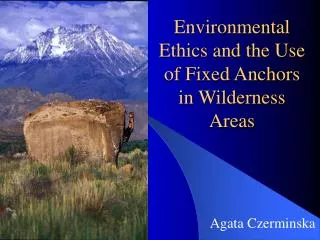
Environmental Ethics and the Use of Fixed Anchors in Wilderness Areas
120 likes | 243 Vues
This article examines the contentious issue of fixed anchors, such as bolts and pitons, in federally designated wilderness areas. It reflects on the "Bolting War," highlighting the 1997 ban on anchors in the Sawtooth Wilderness, its repeal in 1998 due to climber opposition, and the ensuing debates within the Negotiated Rulemaking Advisory Committee. Key arguments include interpretations of the Wilderness Act and the impact of climbing on biodiversity and local economies. Recommendations for policy include comprehensive studies and site-specific regulations to balance recreation and environmental protection.


Environmental Ethics and the Use of Fixed Anchors in Wilderness Areas
E N D
Presentation Transcript
Environmental Ethics and the Use of Fixed Anchors in Wilderness Areas Agata Czerminska
Fixed Anchors • Rock Climbing • Nylon slings, Metal bolts and pitons • Pounded or drilled into cliff
The Bolting War Can climbers legally place anchor bolts in federally designated wilderness areas?
The Battle Erupts • 1997: Anchors banned in Sawtooth Wilderness Area in Idaho • June 1998: Ban extended to include all wilderness areas • Fierce opposition from climbing groups • August 1998: Ban repealed
Negotiated Rulemaking • Fixed Anchors in Wilderness Negotiated Rulemaking Advisory Committee met on four separate occasions through the summer of 2000 • Committee comprised of 21 representatives from organizations such as Wilderness Watch (anti-bolt) and the Access Fund (very pro-bolt)
Interpreting the Wilderness Act Access Fund: • Fixed anchor ban contradicts the Wilderness Act’s provision to provide for primitive and unconfined types of recreation • Climbing is a legitimate use of public lands and permanent fixed anchors must sometimes be used to ensure climbing safety
Interpreting the Wilderness Act Wilderness Watch: • Fixed anchors are permanent installations as defined by the Wilderness Act and therefore violate the act • Bolts would open the hills to mountain bikes, ATVs, and snowmobiles
“After a decade of war in the hills, environmentalists and rock rats draft a treaty” But do they?
Neg-Reg Results • No consensus was reached
Ethical Analysis • Approach in the meetings: Deontological – contending parties discussed their different interpretations of the Wilderness Act
Key Factors Missing in Debates • The impacts of anchors on wildlife and biodiversity • Public opinion • The role rock climbing plays in local economies, which are tied to recreational use of public lands
Policy Recommendations • Comprehensive study on the effects of climbing on cliff habitats • Site specific regulations • In some situations: permits limiting number of climbers