Download
1 / 4
40 likes | 181 Vues
This simulation explores the future trajectory of Kepler-78b, a planet located approximately 0.01 AU from its host star, making it too close for typical planet formation. Using a simplified star-planet model based on real SI units and the Runge-Kutta method, we analyze the transition state of its orbit, expected to decay over time. The simulation utilizes the gravitational forces acting on Kepler-78b and the star's wobble to predict its orbital behavior. Keywords such as planet-star separation, mass, and gravitational dynamics are integral in this study.

E N D
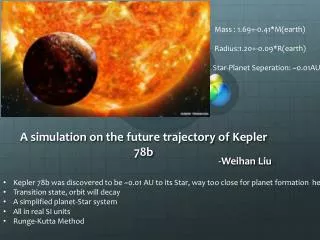
Mass : 1.69+-0.41*M(earth) Radius:1.20+-0.09*R(earth) Star-Planet Seperation: ~0.01AU A simulation on the future trajectory of Kepler 78b • Kepler 78b was discovered to be ~0.01 AU to its Star, way too close for planet formation here • Transition state, orbit will decay • A simplified planet-Star system • All in real SI units • Runge-Kutta Method -Weihan Liu
M(star)/kg 1.65087*(10^30) M(planet)/kg 1.009268*(10^25) Fg= -(G*(ms*mp)./(norm(rs-rp))^3).*(rs-rp) 149,597,870,7m 0.01AU Fdrag= (-(10^28)/norm(rs-rp)).*vp
Wobble of the Star Orbit trajectory
Run my simulation in: • main_code.m • kepler_ode.m