Exploring Dark Romanticism: Poe, Melville, and Hawthorne's Pessimistic Views on Humanity
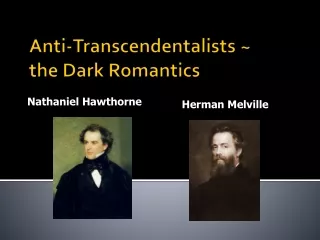
This exploration of Dark Romanticism delves into the works of Edgar Allan Poe, Herman Melville, and Nathaniel Hawthorne, highlighting their shared skepticism towards Emerson's optimistic outlook on human nature. Through themes of madness, obsession, grief, and the ambiguity of good and evil, these authors tackle the complexities of the human spirit. Their writings reflect a profound understanding of isolation, guilt, and moral duplicity, inviting readers to confront the darker facets of existence and the psychological turmoil that arises within society's constraints.

Exploring Dark Romanticism: Poe, Melville, and Hawthorne's Pessimistic Views on Humanity
E N D
Presentation Transcript
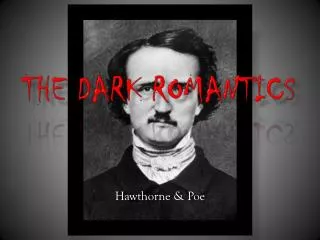
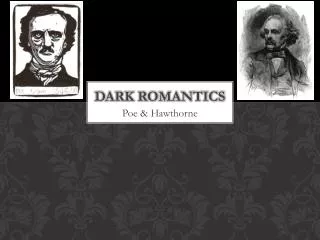
Dark Romantics Poe, Melville, and Hawthorne
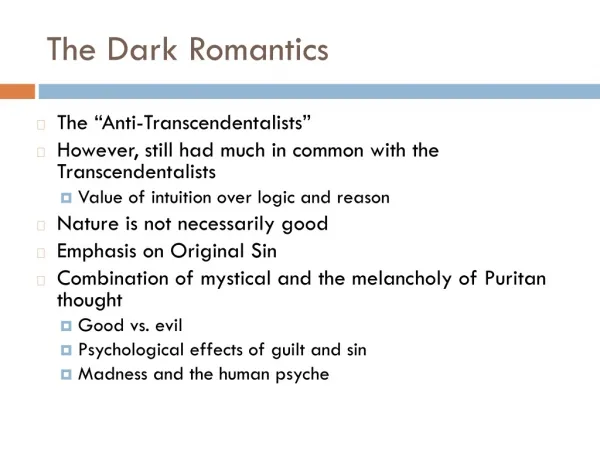
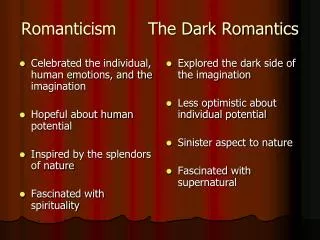
Dark Romantic Beliefs Shares Emerson’s view of the symbolic aspects of nature especially as a symbol of the human spirit • Rejects Emerson’s optimism about humans. Tends to deal with the darker aspects of human nature: I.e madness, obsession, secret sin, violence, and duplicity.
Edgar Allan Poe • Arabesque--use of the supernatural to symbolize the human condition • Grotesque--Heightening of one aspect of a character’s personality • Death--The death of a loved one and the effects of grief on the psyche.
Melville • Ambiguity--It is often difficult to distinguish good from evil. Melville’s symbols, like nature itself, are open to a variety of interpretations. • Madness--Often caused by ambiguity or the attempt to surpass the limits of knowledge • Individuals vs. Society
Hawthorne Alienation - a character is in a state of isolation because of self-cause, or societal cause, or a combination of both. Problem of Guilt -a character's sense of guilt forced by the puritanical heritage or by society; also guilt vs. innocence.