Understanding Co-Terminal Angles and Standard Position in the Unit Circle
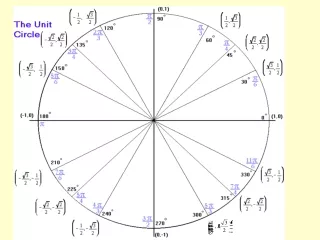
This educational resource covers the concept of co-terminal angles in the unit circle. It explains how to label quadrants (I, II, III, IV) and emphasizes the importance of direction—counter-clockwise for positive angles and clockwise for negative angles. It introduces the standard position of an angle, where the initial side lies on the positive x-axis. The resource also includes practice problems involving coterminal angles, encouraging students to sketch various angles and identify pairs of coterminal angles like 240° and 600°.


Understanding Co-Terminal Angles and Standard Position in the Unit Circle
E N D
Presentation Transcript
The Unit Circle Co-Terminal Angles
Remember • Label the following quadrants: II I IV III • When labeling, did you move clockwise or counter-clockwise? counter-clockwise
Standard position • An angle that is in standard position means that the initial sideof the angle is on the positive x-axis. • Where the angle ends is said to be the terminal side.
Direction • An angle can move counter-clockwise (positive). 135° is the same as -225° 135° -225° • Or clockwise (negative).
Many turns • A wheel can turn many times:
Practice 2. Circle the pair of coterminal angles: 240° & 600° 90° & 290° -100° & 100° 1. Sketch the following angles: 120° -195° 400° 3. Name a positive then a negative angle that is coterminal with 20°.