The Energy Converters: Chloroplasts and Mitochondria in Cellular Respiration and Photosynthesis
100 likes | 219 Vues
Chloroplasts and mitochondria are essential organelles in eukaryotic cells that convert energy into usable forms. Chloroplasts transform sunlight into ATP and carbohydrates through photosynthesis, while mitochondria generate ATP from the breakdown of glucose and other fuels via cellular respiration. Both organelles possess double membranes, internal ribosomes, DNA, and enzymes for energy transformation. Their structures maximize surface area for ATP synthesis, demonstrating their critical roles in energy production and metabolic activity within cells.


The Energy Converters: Chloroplasts and Mitochondria in Cellular Respiration and Photosynthesis
E N D
Presentation Transcript
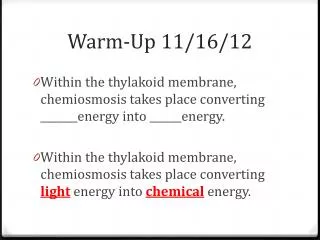
Warm-Up 11/16/12 • Within the thylakoid membrane, chemiosmosis takes place converting _______energy into ______energy. • Within the thylakoid membrane, chemiosmosis takes place converting lightenergy into chemicalenergy.
The Cell: Chloroplasts & Mitochondria Mrs. Ferenc Biology
ATP ATP + Overview • Mitochondria & chloroplasts are the organelles that convert energy to useable forms for the cell • chloroplasts: from sunlight to ATP & carbohydrates • ATP = active energy • carbohydrates = stored energy (think “carb loading) • Mitochondira: from glucoseto ATP
Mitochondria & Chloroplasts • Important to see the similarities • transform energy • generate ATP • double membranes = 2 membranes • internal ribosomes, DNA & enzymes
Chloroplasts Why internal sac membranes? increase surface area for membrane-bound enzymes that synthesize ATP • Type of plastid • Structure • 2 membranes • outer membrane • inner membrane • internal fluid-filled space = stroma • DNA, ribosomes & enzymes • thylakoids = membranous sacs where ATP is made • grana = stacks of thylakoids
Chloroplasts • Function • photosynthesis • generate ATP & synthesize sugars • transform solar energy into chemical energy • produce sugars from CO2 & H2O
Mitochondria • Almost all eukaryotic cells have mitochondria • there may be 1 very large mitochondrion or 100s to 1000s of individual mitochondria • number of mitochondria is correlated with aerobic metabolic activity • more activity = more energy needed = more mitochondria
Mitochondria Why 2 membranes? increase surface area for membrane-bound enzymes that synthesize ATP • Structure • 2 membranes • Cristae • Folds to increase surface area, allows more energy to be obtained within cell • Fluid space between 2 membranes • internal fluid-filled space • mitochondrial matrix • DNA, ribosomes & enzymes
Mitochondria • Function • cellular respiration • generate ATP • from breakdown of sugars, fats & other fuels • in the presence of oxygen • break down larger molecules into smaller to generate energy • generate energy in presence of O2 = aerobic respiration
Any Questions??Today’s Assignment: Chloroplast & Mitochondria Packet