Fascinating Facts About the Brown-Throated Three-Toed Sloth
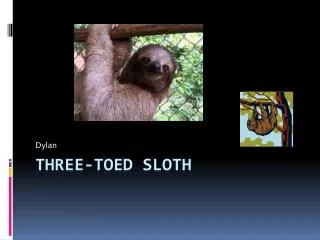
The brown-throated three-toed sloth (Bradypus variegatus) is a unique mammal found in Central and South America. This species is characterized by its brownish-blonde, thick, and woolly coat, often tinged with green due to algae. With a diet primarily consisting of leaves, fruits, and veggies, sloths rely on sunlight to digest their food. They are known for their slow movements and intriguing behaviors, such as monogamous relationships and lengthy parental care. Learn about their habitat, diet, conservation status, and more remarkable traits!

Fascinating Facts About the Brown-Throated Three-Toed Sloth
E N D
Presentation Transcript
Classification • Kingdom- Animilia • Phylum-Chordata • Subphylum-Vertebrata • Class- Mammilia • Order-Pilosa • Family-Bradypodidae • Genus-Bradypus • Species-Bradypus variegates
Close Relations • The Armadillo • The Anteater
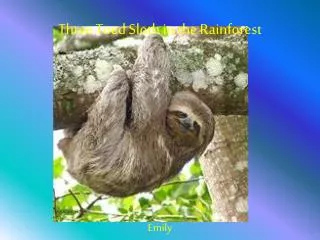
Physical Characteristics • Has a brownish blonde coat • Very thick and woolly type • Very very dirty • Has a bit of algae in their fur • Has a greenish tint in their fur
Differences • Male weighs about 4.45kg(9.80lb) • Female weighs about 4.22kg(9.30lb) • The males have two yellowish strips running down their backs while the females do not
Dristribution • South Central America • South America
Habitat • Tropical rainforests • Semi-deciduous forests • Sub tropical forests • Sub tropical lowlands and swamps • Seeks trees with large crowns • Elevations at sea level to 2400 meters high
Conservation Status • They are at Least Concern • Pop trend is unknown • Increasing
Reproduction • Females are Monogamous • Female attracts male when ready to mate • Have about one baby a year • Prior to a rainy season • Will mate with the first male they meet • Males are mature at around 4 years • Females are mature at 3 years • Spend half a year in pregnancy
Parental Care • With their mom for 5 to 8 months • The father takes no help with the child
Longevity and Mortality • Lives for 30 to 40 years in the wild • Lives for 30 to 40 years in captivity
Seasonal Patterns • There are no behavior changes • They undergo torpor
Diet • They mainly eat leaves from the trees • Fruits • Veggies • They get water from the ingested plant material
Predator Relationships • Spectacled owls • Harpy eagles • Variety of felid • Cougars • No Humans
Fun Facts • Sloths need sunlight to digest food because they will die of a full stomach • Sloths have excelentcamoflouge • They have a shriek that they use when their ready to mate • Their claws can make really deep cuts in our skin
Works Cited • Allaby, Michael. Biomes of the Earth Tropical Forests. Illus. Richard Garratt. New York: Chelsea, 2006. • Animal Diversity Web. Regents of the University of Michigan, 2012. Web. 24 Feb. 2013. <http://animaldiversity.ummz.umich.edu/accounts/Bradypus_variegatus/>. • Attenborough, David. The Life of Mammals. Illus.David Attenborough. Princeton: Princeton UP, 2002. • Fulbright, Jeannie K. Land Animals of the Sixth Day. 3rd ed. Anderson: Apologia Education Ministries, 2008. Print. Exploring creation with Zoology 3. • IUCN Red List. Species survival commission, 2013. Web. 21 Mar. 2013. <http://www.iucnredlist.org/>. • Lang, Aubrey. Baby Sloth. Illus. Wayne Lynch. Markham: Fitzhenry and Whiteside, 2004 • Stewart, Malissa. Sloths. Minneapolis: Carolrhoda, 2005. • World Land Trust. England & Wales, 2011. Web. 24 Feb. 2013. <http://www.worldlandtrust.org/education/species/ brown-throated-three-toed-sloth>.