Understanding and Testing Conjectures in Mathematics
This lesson focuses on making and testing conjectures by drawing generalizations based on observed patterns. Students will explore the concept of conjectures, such as "It always rains when it is cloudy" or "All even numbers are divisible by 2." Through guided questions, students will learn how to form conjectures about numbers, particularly multiples of 10, and test their conjectures against numerical examples. By investigating properties of odd and even numbers, students will develop critical thinking and reasoning skills essential for mathematical exploration.

Understanding and Testing Conjectures in Mathematics
E N D
Presentation Transcript
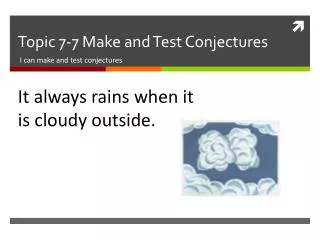
Topic 7-7 Make and Test Conjectures I can make and test conjectures It always rains when it is cloudy outside.
Lesson Video • Pearson Success Net
Vocabulary • Conjecture • A generalization that you think is true • All even numbers are divisible by 2. • I think this is true because 8, 10, and 12 can all be divided by 2. • The commutative property of multiplication is NOT a conjecture because it is a basic property of numbers.
Quick Write • How old are you? Is it reasonable to say that all sixth graders are 8? Why or why not?
Make a generalization about multiples of 10 • Use questions to help you write a conjecture • What are some multiples of 10? • 10, 20, 30, 40, 50 • What do you notice? Do they have anything in common? • They all end in 0. They are all even. • Using this data you could make a conjecture….
Conjecture All multiples of 10 end in 0 or All multiples of 10 are even
Test your conjecture • Find other multiples of 10 to see if you are correct. • Are other multiples of 10 even? Do other multiples of 10 end in 0? • If your answer is yes, then your conjecture is reasonable.
Test these conjectures… • The difference of two odd numbers is always even. • Use examples to decide if it is correct or not • The product of two prime numbers is never an even number. • Use examples to decide if it is correct or not
Make and test a conjecture about odd numbers. • A) Write down 2-3 questions you have about odd numbers • B) Pick one of the questions that you think you know the answer to • AB) Find examples that work for your conjecture