Understanding Complex Systems: Thinking Like Nature Through Emergence and Evolution
50 likes | 171 Vues
This exploration into complex systems reveals how nature can inform our thinking in design and problem-solving. We delve into concepts such as emergence versus reductionism, the wisdom of crowds, and the role of evolutionary processes and genetic algorithms. Through simulations, such as the peppered moth model, we illustrate how survival probabilities depend on environmental interactions rather than direct competition. Learn strategies to externalize thought and evaluate feasibility ranges, distinguishing between engineering margins and nature’s intrinsic processes.


Understanding Complex Systems: Thinking Like Nature Through Emergence and Evolution
E N D
Presentation Transcript
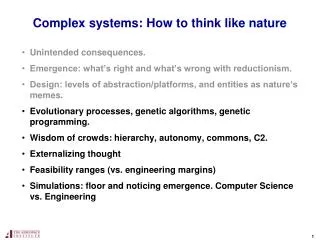
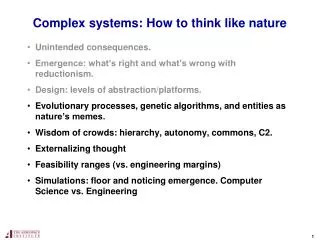
Complex systems: How to think like nature • Unintended consequences. • Emergence: what’s right and what’s wrong with reductionism. • Design: levels of abstraction/platforms. • Evolutionary processes, genetic algorithms, and entities as nature’s memes. • Wisdom of crowds: hierarchy, autonomy, commons, C2. • Externalizing thought • Feasibility ranges (vs. engineering margins) • Simulations: floor and noticing emergence. Computer Science vs. Engineering
Try it out File > Models Library > Biology > Evolution > Peppered Moths Click Open
Peppered moths model • At each time tick, a moth’s probability of survival—not being eaten by predators (not shown)—depends on • How close its color (1-9) is to the background color (0-8). • The “Selection” slider, which controls the impact of the environment. The higher the slider, the more important the environment. • Moths both reproduce and die (of old age). • They may mutate, i.e., have offspring of a different color. • Illustrates the nature of evolution. • Moth (and their colors) are rivals, not competitors. • Nature is not “red in tooth and claw” (in this model). • The moths and their colors don’t compete with each other directly. • Colors confer survival value (fitness) depending on the environment. • More like a race than a boxing match.
20 A C 9 24 7 12 B 13 12 4 12 D 14 E Traveling salesman problem (TSP) • Connect the cities with a path that • Starts and ends at the same city. • Includes all cities. • Includes no city twice. The obvious routes all include the sequence: ACED-54 (or its reverse). The question is where to put B: ABCED-55, ACBED-57, ACEBD-56.
20 A C 9 24 7 12 B 13 12 4 12 D 14 E Genetic algorithm • Create a population of possible paths. • AEBCD-59, ACBED-57, ADCBE-59, ACDEB-71, … • In this case there are only 4! = 24 possible routes. • Could examine them all. Usually that’s not possible. • A second exchange solves the problem. • ACBED-57 → ABCED-55 • Repeat • Select one or two tours as parents. • Better tours are more likely to be selected. • Generate offspring using genetic operators. • (Re)combine two tours: ACBED-57 & ADCBE → ACBED-57. • Exchange two cities: ACDEB-71 → ACBED-57 • Reverse a subtour: ACBED-57 → AEBCD-59 • Possibly mutate the result: ADCBE-59 → ACBDE-70