
Electrodynamic Analysis of Modified IGMA for Aerosol Collection & Radon Daughter Dynamics
This research presents a detailed study of a modified IGMA (Ion Mobility Gradient Analyzer) designed for the collection of ions in aerosol environments. It features an electrostatic filter powered by a DC-DC converter, ensuring efficient ion collection and high voltage manipulation. The study investigates the mobility of ions and the accumulation and decay of radon daughters in various environments, including outdoor air during wintertime and controlled indoor conditions rich in radon. The design allows for logarithmic scanning of ion mobility while managing noise interference effectively.

Electrodynamic Analysis of Modified IGMA for Aerosol Collection & Radon Daughter Dynamics
E N D
Presentation Transcript
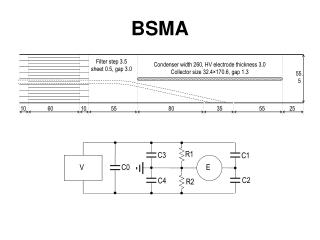
R1 C3 C1 Filter step 3.5 sheet 0.5, gap 3.0 Condenser width 260, HV electrode thickness 3.0Collector size 32.4×170.6, gap 1.3 55.5 V C0 E C2 C4 R2 10 60 10 55 80 35 55 25 BSMA
Aerosol inlet h u E Ballast air(could be recirculated to sheath air) Sheath air inlet a Aerosoloutlet h V b d Plain IGMA
gap 2 + 18 mm step 12.5 mm gap 20 mm Modified IGMA The ions in the outlet are collected by a well-insulated and shielded electrostatic filter powered by an internal battery and DC-DC converter. The collector is connected to the ground through an electrometric amplifier. Electrostatic shielding from the high voltage deflector grid allows free manipulation with mobility control voltage. The deflector grid is connected to a RC circuit with a time constant of about 4 s. The capacitor of this circuit is quickly charged up to 6 kV and slowly discharged through the resistor with a period of 20 s. This assures the logarithmical scanning of mobility from the lowest to the highest value of the mobility range during the 20 s period.
NOISE Noise : cm–3 wintertime outdoor air, rime and light snowfall 30 closed room,rich in radon 20 BSMA IGMA 10 0 3 0.03 0.1 1 0.03 cm2V−1s−1 Mobility 3 cm2V−1s−1 Mobility : cm2V−1s−1
ACCUMULATION AND DECAY OF RADON DAUGHTERS BSMA Fan on Fan off