Structure of circumstellar envelope around AGB and post-AGB stars
Structure of circumstellar envelope around AGB and post-AGB stars. Dinh-V-Trung Sun Kwok, P.J. Chiu, M.Y. Wang, S. Muller, A. Lo, N. Hirano, M. Mariappan, J. Lim Institute of Astronomy and Astrophysics Academia Sinica. Introduction.

Structure of circumstellar envelope around AGB and post-AGB stars
E N D
Presentation Transcript
Structure of circumstellar envelope around AGB and post-AGB stars Dinh-V-Trung Sun Kwok, P.J. Chiu, M.Y. Wang, S. Muller, A. Lo, N. Hirano, M. Mariappan, J. Lim Institute of Astronomy and Astrophysics Academia Sinica
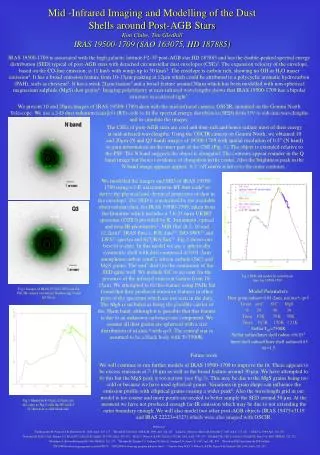
Introduction • Intermediate mass stars (1 M to 8 M) evolve through Asymptotic Giant Branch (AGB) and eventually become Planetary Nebulae (PN) • Mass loss during the AGB phase: 107 to 104 M/yr Morphology of envelope AGB phase: spherically symmetric PPN phase: Bipolar more common PN phase: wide variety of shapes Shaping must occur either at the end of AGB phase or during the short transition stage (proto-planetary nebula PPN).
Program to study the structure of envelopes with the Sub-millimeter Array IRC+10216 CIT 6 R Scl V Hya Pi Gru IRC+10420 VY CMa IRAS 07134+1005 NGC 7027
Envelope around AGB stars is commonly assumed to be spherically symmetric & homogeneous. But in reality the envelope is complicated & interesting ! V - band 1.3 mm dust continuum emission in IRC+10216 Maurron & Huggins (1999) Groenewegen et al. (1997)
IRC+10216 Lucas & Guelin (1999) VLA data of HC5N J=98 at 23 GHz. Synthesized beam ~ 4 arcsec.
SMA CO J=21 emission from R Scl Detached shell !
CO J=21 Detached shell: Vexp ~ 15 km/s Present day wind: Vexp ~ 10 km/s Helium flash ? Dynamical age ~ 1700 yr
Gru CO J=2-1 emission Disk & high velocity outflow are present in envelope of a normal AGB star. Poster by Chiu et al. 2005
Molecular emission from V Hya Disk & collimated high velocity outflow are present Poster by Hirano et al. 2005
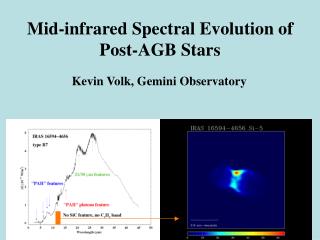
21 m Proto-Planetary nebula IRAS 07134+105 Mid-IR image (Kwok et al. 2002) BIMA CO J=10 image Meixner et al. (2004)
IRAS 07134+1005 CO J=3-2 ~ 2 arcsec.
Schematic view of IRAS 07134+1005 North AGB wind Torus Torus To observer
Model parameters for IRAS 07134+1005 • Expansion velocity of the wind : 10 km/s • Outer spherical AGB wind with mass loss 2 10-6 M/yr • Axi-symmetric torus with mass loss ~ 4 10-5 M/yr • Inner radius of torus ~ 6 1016 cm or 1500 yrs in dynamical age • Outer radius of torus ~ 9 1016 cm or 2000 yrs in dynamical age • Envelope is viewed at 45 degrees from below the equator
CO J=3-2 observation – channel maps Model channel maps
NGC 7027 • Brightest planetary nebula at all wavelengths • Distance ~ 900 pc • Central white dwarf T* ~ 198000 K • Young HII region surrounded by massive molecular envelope. • Rich in molecular lines and carbon chemistry
HST optical images in H, OIII & NII. HST near IR images
CONTINUUM @ 345 GHz Beam : 1.71’’ x 0.85’’ (73°) Total flux : ~ 1.45 Jy @230 GHz Beam : 2.65’’ x 1.52’’ (77°) Total flux : ~ 3.6 Jy JCMT : 3.8 0.2 Jy (Knapp et al. 1993)
Future work • Combine SMA & single dish (JCMT, CSO, HHT) data • recover short spacing flux • Multi-line observations & molecular excitation • physical conditions • Effects of high velocity outflow on circumstellar envelope • radiation hydrodynamics Better understanding of the physics of circumstellar envelopes.
R Scl Scattered light polarization CO J=21
Histogram: CO J=3-2 from HHT 10m telescope Red solid line: CO J=3-2 profile predicted by model