Comprehensive Guide to Automatic External Defibrillation and CPR Integration
This detailed guide by Aaron J. Katz, AEMT-P, CIC, outlines the essential protocols for using Automatic External Defibrillators (AEDs) within the context of CPR, based on the 2005 AHA guidelines. It covers critical concepts such as heart rhythms including VTACH, VFIB, and asystole, as well as the process of assessing a patient, integrating AED use, and performing effective CPR. The text also discusses common AED errors, complications, and solutions to optimize patient outcomes during cardiac emergencies.

Comprehensive Guide to Automatic External Defibrillation and CPR Integration
E N D
Presentation Transcript
Automatic External Defibrillation Aaron J. Katz, AEMT-P, CIC www.es26medic.net Revised for 2005 AHA Protocols
AHA Chain of Survival • Early access • Early CPR • Early defibrillation • Early ALS
Cardiac electrophysiology • SA Node • “dominant pacemaker” • “Fires” 60-100 times per minute • Internodal pathways • AV Node • Bundle of HIS • Left and right bundle branches • Purkinje network
Nonperfusing heart rhythms • Ventricular tachycardia (“VTACH”) • Ventricular fibrillation (“VFIB”) • Asystole • Electromechanical dissociation (EMD) • Pulseless electrical activity (PEA)
The bottom line • All the above abnormal heart rhythms can not produce a perfusing pulse • Pulseless VTACH and VFIB CAN be successfully converted to a perfusing rhythm using a defibrillator
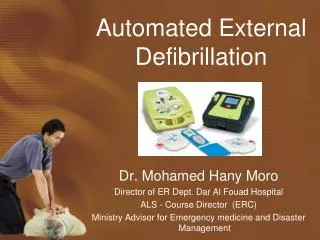
AED – the technology • Very accurate computer enabling recognition of lethal rhythms (“Analyze”) • Modern AED will talk • Shocking mechanism (“Shock”) • Automatic vs. semiautomatic
Common AED errors • Bad battery • Patient moving • AED applied to a responsive patient
Bad battery • Use fully charged batteries • Depends on manufacturer • Pay attention to AED warnings about batteries • Bad batteries are uncommon today • COLD WEATHER
Patient moving • Causes inaccurate analysis • Don’t touch the patient • Stop the bus when analyzing!
AED applied to a responsive patient • AED applied to a responsive patient with a rapid pulse • AED may falsely interpret as VTACH – and recommend shock • Therefore: only apply AED to an unresponsive pulseless patient
Complications & solutions • Patient has a pacemaker • Apply pads 1” from pacemaker • AICD • No danger to EMT! • Small amount of energy • Apply pads 1” from pacemaker • Very hairy chest • Shave the area • Keep a disposable razor with your defibrillator
AED integration • Arrive at the scene • Assess responsiveness • Stop CPR (EMTs or bystanders) • Verify pulselessness & apnea • EMS Witnessed Arrest? • Perform CPR until defibrillator is attached • Arrest not witnessed by EMS? • Two minutes of CPR prior to using defibrillator
AED integration – cont’d • Prepare for defibrillation: • Bare the chest • Remove nitro paste/patches • Apply pads to the chest • Look at the pads, they show you how • Right: right of sternum under clavicle • Left: left ribs • Top of pad should 2-3” below armpit • Apply them smoothly • STOP CPR
AED integration – cont’d • Shout “clear” 3 times • “I’m clear, you’re clear, everybody clear” • Analyze • AED may tell you “analyzing – do not touch the patient” • Results…
AED integration – cont’d • Analysis at any time will result in either: • Shock advised • AED will charge and tell you to clear the patient and press shock • No shock advised • Patient may have a pulse • Patient has a nonshockable rhythm • Asystole, EMD/PEA
Shocks recommended • One Shock • Check pulse… • Two minutes of CPR • Press Analyze • Shock if recommended • Two minutes of CPR • …
Continue • After 3 cycles of CPR or if spontaneous breathing occurs, begin transport • During transport, continue CPR, re-analyze every 2 minutes, and shock as indicated
No shock advised • No spontaneous breathing? • 2 minutes of CPR • Analyze/Shock as indicated/2 minutes of CPR cycles • Spontaneous breathing • Assess vital signs • Support airway • Support breathing • Transport