Understanding Inverse Functions in Calculus II: One-to-One Functions and Their Properties
90 likes | 221 Vues
Inverse functions are a critical concept in Calculus II, particularly for one-to-one functions. A function ( f ) is one-to-one if it never takes the same value twice, which can be verified using the Horizontal Line Test. This states that a function is one-to-one if any horizontal line intersects its graph at most once. For a one-to-one function ( f ) with domain ( D ) and range ( R ), its inverse ( f^{-1} ) exchanges the roles of domain and range. This guide also covers how to find inverse functions and properties such as symmetry about the line ( y = x ).


Understanding Inverse Functions in Calculus II: One-to-One Functions and Their Properties
E N D
Presentation Transcript
7.1 Inverse Functions Math 6B Calculus II
One to One Function • A function f is called a one-to-one function if it never takes on the same value twice; that is • Horizontal Line Test A function is one-to-one if and only if no horizontal line intersects its graph more than once.
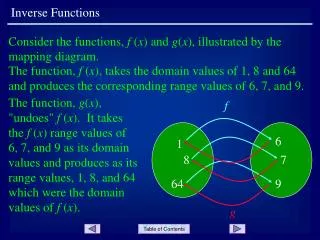
Inverse Functions • Let f be a one-to-one function with domain Dand range R. Then its inverse function f -1has domain Rand range Dand is defined by for any y in R.
Inverse Functions domain of f -1 = range of f range of f -1 = domain of f f –1does not mean 1/f (x)
Existence of Inverse Functions Let f be a one-to-one function on a domain D with a range of R. Then f has a unique inverse f -1 with domain R and range D such that and where x is in D and y is in R.
How to Find the Inverse of a One-to-One Function • Replace f (x) with y. • Interchange x and y. • Solve this equation for yin terms of x(if possible). • Replace y with f–1(x). The resulting equation is y = f–1(x).
Graph of a Inverse Function A function and its inverse will always have symmetry about the line y = x.
The Calculus of Inverse Functions • If f is a continuous function defined on an interval, then its inverse function f–1 is also continuous.
Derivative of the Inverse Function • Let f be differentiable and have an inverse on the interval I. If x0 is a point on the interval I at which then f-1is a differentiable at and )() = ,where =