Understanding Population Ecology: Characteristics, Distribution, and Estimation Techniques
Explore the fundamentals of population ecology, focusing on the characteristics of populations, including geographic distribution, density, growth rate, and age structure. Learn about the types of population distributions: random, uniform, and clumped, and the factors influencing these patterns. Delve into population sampling methods like mark and recapture and random sampling, which are essential for estimating wildlife populations. This resource provides insights into the dynamics of species within their habitats and how to measure their abundance effectively.

Understanding Population Ecology: Characteristics, Distribution, and Estimation Techniques
E N D
Presentation Transcript
Population Ecology
Population – all the individuals of the same species in a specific area. 4 characteristics of populations: • Geographic distribution • Density • Growth rate • Age
1. Geographic distribution – where the population is located, its range 2. Population Density - number of organisms per square unit volume Which state is the most densely populated?
A. Random - some areas with many individuals, some with few.ex: seeds dispersed by windB.Uniform (Even) - all areas with the same number and the same distance between organisms. ex: trees in an orchard
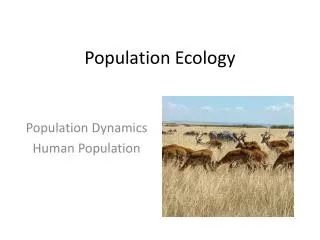
C. Clumped – groups of many individuals, with large spaces between the groupsClumped distribution could result from individuals using a common resource ex:buffalo around water holes
1. What else might cause organisms to be clumped? 2. What else might cause organisms to be evenly distributed? 3. Which of these 3 types of distributions would be least likely to occur for a population of organisms in nature? 4. When might a population be both uniform and clumped?
Population Sampling: 2. Mark and recapture – animals are caught, tagged and released. They are periodically recaptured, and a formula is used to estimate the population: Number caught x number tagged number caught with tag 1. Random sampling – estimating a population by sampling a small area and scaling up. ex: if there are 5 in one square foot, there would be 50 in 10 square feet.