Download
1 / 10
100 likes | 238 Vues
This resource provides a comprehensive overview of Valence Shell Electron Pair Repulsion Theory (VSEPRT), which explains how electron pairs in the valence shell determine molecular shapes and bond angles. Through structural formulas, students will learn to describe the molecular geometry of various atoms, identifying shapes such as linear, bent, trigonal planar, pyramidal, tetrahedral, and trigonal bipyramidal. Each shape’s geometry and corresponding bond angles will be highlighted with examples, enhancing understanding of chemical bonding and molecular structure.

E N D
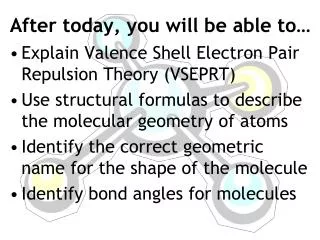
After today, you will be able to… • Explain Valence Shell Electron Pair Repulsion Theory (VSEPRT) • Use structural formulas to describe the molecular geometry of atoms • Identify the correct geometric name for the shape of the molecule • Identify bond angles for molecules
Day 4 - Notes Unit 4: Chemical Bonding Molecular Geometry
Molecular Geometry • Valence Shell Electron Pair Repulsion Theory (VSEPR):The electron pairs (both shared and unshared) in the outermost energy level try to get as far apart from each other as possible. • This determines the shape of the molecule.
Shape: Linear 2 atoms • Example: H2 3 atoms • Example: CO2 ~180˚ O H C H O Central atom must have NO unshared pairs
Shape: Bent 3 atoms • Example: H2O O Central atom can have one or two unshared pairs of electrons H ~104.5˚ H
Shape: Trigional Planar 4 atoms • Example: CH2O O ~120˚ C Central atom has NO unshared pairs H H
Shape: Pyramid 4 atoms • Example: NH3 Central atom has one unshared pair H H N ~107.5˚ H
Shape: Tetrahedral 5 atoms • Example: CH4 Central atom has NO unshared pairs H ~109.5˚ H H C H
Shape: Trigional Bipyramidal • 6 atoms • Example: PF5 Central atom has NO unshared pairs F ~90˚ F F F ~120˚ P For elements in period 3 and higher, when bonded to Cl or F, will have an expanded octet. F
Summary of Shapes Linear Bent Trigional planar Pyramid Tetrahedral Trigional bipyramidal