Complexity Results and Existence of Nash Equilibria in Noncooperative Games
This document presents the findings on the complexity of Nash equilibria in noncooperative games, derived from key research by Vincent Conitzer and Tuomas Sandholm. It addresses critical problems in game theory, highlighting that many existence questions for equilibria in general normal-form games are NP-hard. The agenda covers literature on mixed-strategy Nash equilibria, pure-strategy Bayes-Nash equilibria, and challenges in finding equilibria within various game structures. Additionally, it examines the complexities arising in symmetric two-player games, stochastic games, and the implications for algorithm design.

Complexity Results and Existence of Nash Equilibria in Noncooperative Games
E N D
Presentation Transcript
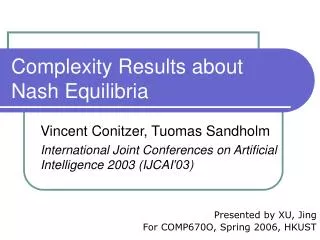
Complexity Results about Nash Equilibria Vincent Conitzer, Tuomas Sandholm International Joint Conferences on Artificial Intelligence 2003 (IJCAI’03) Presented by XU, Jing For COMP670O, Spring 2006, HKUST
Problems of interests • Noncooperative games • Good Equilibria • Good Mechanisms • Most existence questions are NP-hard for general normal form games. • Designing Algorithms depends on problem structure.
Agenda • Literature • A symmetric 2-player game and results on mixed-strategy NE in this game • Complexity results on pure-strategy Bayes-Nash Equilibria • Pure-strategy Nash Equilibria in stochastic (Markov) games
Literature • 2-player zero-sum games can be solved using LP in polynomial time (R.D.Luce, H.Raiffa '57) • In 2-player general-sum normal form games, determining the existence of NE with certain properties is NP-hard (I.Gilboa, E.Zemel '89) • In repeated and sequential games (E. Ben-Porath '90, D. Koller & N. Megiddo '92, Michael Littman & Peter Stone'03, etc.) • Best-responding • Guaranteeing payoffs • Finding an equilibrium
A Symmetric 2-player Game • Given a Boolean formula in conjunctive normal form, e.g. (x1Vx2)(-x1V-x2) • V={xi}, 's set of variables, let |V|=n • L={xi, -xi}, corresponding literals • C: 's clauses, e.g. x1Vx2, -x1V-x2 • v: LV, i.e. v(xi)=v(-xi)= xi • G(): • =1=2= LVC{f}
A Symmetric 2-player Game • Utility function
A Symmetric 2-player Game • u1(a,b) =u2(b,a)
Theorem 1 • If (l1,l2,…,ln) satisfies and v(li) = xi, then • There is a NE of G() where both players play li with probability 1/n, with E(ui)=1. • The only other Nash equilibrium is the one where both players play f, with E(ui)=0. Proof: • If player 2 plays li with p2(li)=1/n, then player 1 • Plays any of li, E(u1)=1 • Plays –li, E(u1)=1-3/n<1 • Plays v, E(u1)=1 • Plays c, E(u1)≤1, since every clause c is satisfied.
Theorem 1 • No other NE: • If player 2 always plays f, then player 1 plays f. • If player 1 and 2 play an element of V or C, then at least one player had better strictly choose f. • If player 2 plays within L{f}, then player 1 plays f. • If player 2 plays within L and either p2(l)+p2(-l)<1/n, then player 1 would play v(l), with E(u1)>2*(1-1/n)+(2-n)*(1/n)=1. • Both players can only play l or -l simultaneously with probability 1/n, which corresponds to an assignment of the variables. • If an assignment doesn’t satisfy , then no NE.
A Symmetric 2-player Game • u1(a,b) =u2(b,a)
Corollaries • Theorem1: Good NE is satisfiable.
Corollaries • Hard to obtain summary info about a game’s NE, or to get a NE with certain properties. • Some results were first proven by I. Gilboa and E. Zemel ('89).
Corollaries • A NE always exists, but counting them is hard, while searching them remains open.
Bayesian Game • Set of types Θi , for agent i (iA) • Known prior dist. over Θ1 Θ2…Θ|A| • Utility func. ui: Θi12…|A| R • Bayes-NE: • Mixed-strategy BNE always exists (D. Fudenberg, J. Tirole '91). • Constructing one BNE remains open.
Complexity results • SET-COVER Problem • S={s1,s2,…, sn} • S1, S2, …, SmS, Si=S • Whether exist Sc1, Sc2, … , Sck s.t. Sci=S ? • Reduction to a symmetric 2-player game • Θ= Θ1= Θ2={1, 2,…, k,} (k types each) • is uniform • = 1= 2={S1, S2, …, Sm, s1,s2,…, sn} • Omit type in utility functions
Complexity results • Theorem 2: Pure-Strategy-BNE is NP-hard, even in symmetric 2-player games where is uniform. Proof: • If there exist Sci, then both player play Sci when their type is i. (NE) • If there is a pure-BNE, • No one plays si • {Si (for i)} covers S.
Theorem 3 • PURE-STRATEGY-INVISIBLE-MARKOV-NE is PSPACE-hard, even when the game is symmetric, 2-player, and the transition process is deterministic. (PNPPSPACEEXPSPACE)