Understanding Similar Polygons: Concepts and Examples
120 likes | 263 Vues
This guide explores the properties of similar polygons, highlighting the key distinctions between similar and congruent figures. It emphasizes that similar polygons maintain equal corresponding angles, while their sides are proportional. The scale factor serves as the ratio of corresponding sides, allowing for comparison between shapes. Various examples illustrate how to determine if polygons are similar, identify congruent angles, and calculate scale factors. This resource is essential for mastering the concepts of similarity in geometry, with practical applications in scaled drawings and real-world examples.


Understanding Similar Polygons: Concepts and Examples
E N D
Presentation Transcript
8-2 Similar Polygons Unit 8 Similarity
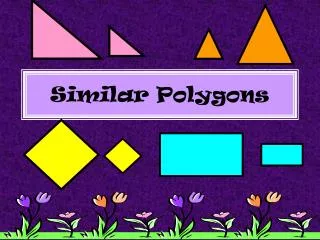
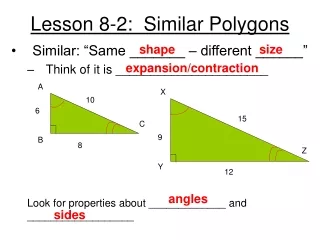
Notes • Similarfigures have the same shape, but not necessarily the same size.
Notes • In congruent polygons, corresponding angles and sides are equal. In similar polygons, corresponding angles are still equal but corresponding sides are proportional.
Notes • The scalefactor of two similar shapes is the (reduced) ratio of corresponding parts. • The scale factor of ΔABC to ΔDEF is ___________.
Notes • If all corresponding parts of figures are proportional, then they are similar.
Examples • 1.) • A.) What are the pairs of congruent angles? • B.) What is the extended proportion for the ratios of corresponding side lengths?
Examples • 2.) Are the polygons similar? If they are, write a similarity statement and give the scale factor. • A.) ABC and FED
Examples • 2.) Are the polygons similar? If they are, write a similarity statement and give the scale factor. • B.) LMNO and QRST
Notes • In a scaledrawing, all lengths in the drawing are proportional to their corresponding actual lengths. The scale is the ratio of lengths in the drawing to the actual size. • For example, a map is always proportional to the actual distance and a scale is always provided.
Examples • 3.) WXYZ ~RSTZ. What is the value of x?
Examples • 4.) Jan uses overhead projector to enlarge a picture 5 in. high and 7 in. wide. She projects the picture on a blackboard 4 ft 2 in. high and 12 ft wide. What are the dimensions of the largest picture that can be projected on the blackboard?