Download
1 / 11
110 likes | 232 Vues
This analysis explores the physics of a roller coaster navigating a hill and a loop. Part A calculates the speed at the bottom of a 20m hill, utilizing energy conservation principles. Part B determines the speed at the top of a 15m loop, incorporating gravitational and kinetic energy equations. Finally, part C examines the deceleration caused by drag when the coaster runs on a flat track in a frictionless scenario. The calculations reflect fundamental physics concepts while considering real-world factors like air density and drag coefficient.

E N D
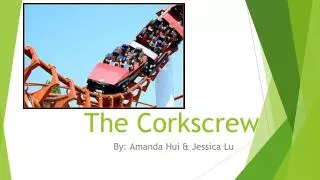
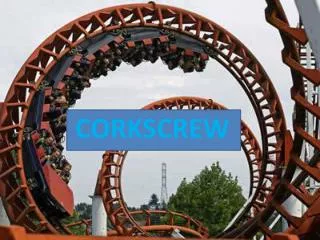
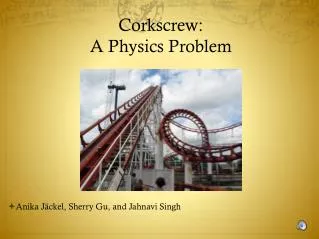
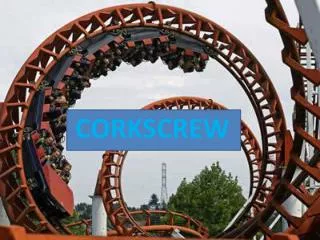
QUESTION: The roller coaster is at the top of the hill 20m high and moving at a speed of 10m/sec.
a) (assume no friction) How fast will the coaster be moving at the bottom of the hill before going into the loop?
b) (assume no friction) How fast will the roller coaster be moving at the top of a loop which is 15m high?
The density of air is 1.75 kg/m3, the area of the coaster is 4m2, and the drag coefficient for the coaster is 0.8.
c) (in a perfect physics world) If the wind starts up after going out of the loop; a drag force is created to stop the coaster. Find the deceleration of the coaster if the coaster is running on a flat track.
A Since gravitational potential energy is 0 at the bottom; PE and mass cancels out. ½v2 = ½v2 250 = ½v2 2 x 250 = v2 √500 = v 22.36 = v
B PE + KE = PE + KE Mgh + 1/2mv2 = mgh + 1/2mv2 (9.8)(20) + ½(10)2 = (9.8)(15) + ½ v2 196 + 50 = 147 + ½ v2 2(246-147) = v2 √198 = v 14.07 = v
CFd = ma½pv2CdA = ma ½(1.75)(22.36)2(0.8)(4) = 400a1399.91488 = 400a1399.91488/400 = a3.50 m/s2 = a