Molecular Shape and Structure
Learn how to determine the 3-D shape of molecules using Lewis structures and VSEPR theory. Explore different molecular shapes based on electron pair orientations and the number of electron pairs. Understand molecular polarity and symmetry.

Molecular Shape and Structure
E N D
Presentation Transcript
Things to remember • The shape of a molecule: • determined by where the nuclei are located • nuclei go to certain locations because of its electron pairs
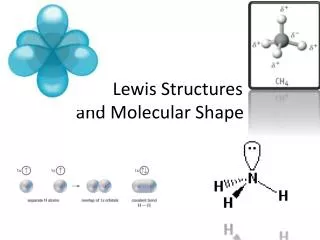
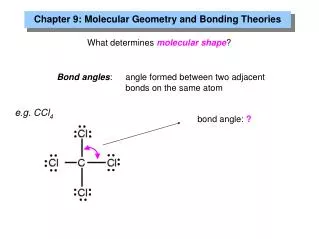
Use the Lewis Structure • Lewis structure is 2-D, but it can help you figure out the 3-D shape
Atom Lewis Structure # Unpaired Electrons Bonding Capacity . H H 1 1 .. F, Cl, Br, I ·F: 1 1 .. . C, Si ·C· 4 4 . .. N, P ·N· 3 3 . O, S ·O: 2 2 · ·· Ne, Ar, Kr :Ne: 0 0 ·· Bonding Capacity ..
Molecular Shape • Determined by overlap of orbitals • Shape determined by two factors: • The total number of atoms & • The number of electron pairsin different locationson central atom Classify electron pairs as bonding or nonbonding
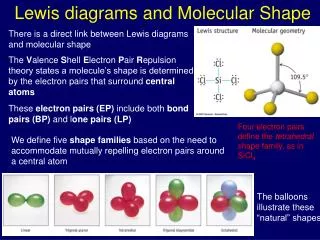
Molecular Shape & VSEPR • Electron pairs repel each other: • want to be as far apart from each other as can be • Nonbonding pairs take up a little more room than bonding pairs
Total Number of Electron Pairs Orientation 1 or 2 Linear: 2 electron pairs can be 180 apart 3 Planar Triangular: 3 electron pairs - 120 apart 4 Tetrahedral: 3-D, 4 electron pairs - 109 apart Orientation of Electron Pairs
2-Atom Molecules • Atoms are located right next to each other • these are linear molecules!
Linear Bent 3-Atom Molecules • Most likely possibilities are linear and bent
.. .. .. .. CO2 Lewis structure: O :: C :: O 4 bonding pairs But only2 regionsof electron density 180 apart so CO2 is linear
Lewis Structure of H2O = H:O:H .. Count up the electron pairs: H2O .. • 2 bonding pairs between O and the H’s • 2 nonbonding pairs on the O • 4 different regions of electron density
H2O • 4 electron pairs are 109 apart • nonbonding pairs spread out a bit more • squeeze the bonding pairs together • bent shape
3-Atom Molecules • Triangular? Yes, ozone (O3) is triangular
.. .. F .. .. .. .. .. F .. .. BF3: Trigonal Planar • B has 3 valence electrons. It’s a very small atom. Each F has 7 valence electrons. Total = 3 X 7 + 3 = 24 : F : B These molecules don’t obey the octet rule - so aren’t likely to see them - 3 regions - FBF = 120 ..
4-Atom Molecules • Two possibilities: • Trigonal Planar – in 1 plane • Trigonal Pyramidal
.. Lewis Structure: H : N : H .. NH3 H • 3 bonding pairs • 1 nonbonding pair • 4 regions • 109 apart
H Lewis structure = H : C : H .. H CH4 .. • 4 bonding pairs • 4 regions of electron density • Electron pairs are 109 apart
4-Atom Molecules: Trigonal Planar Bond angles =120 All 4 atoms lie in the same plane You aren’t likely to see this because thesemolecules don’t obey the octet rule!
4-atom molecule • Shape = trigonal pyramid • A bit less than 109
4-Atom Molecules: AX3 The shape you are most likely to see
5 Atoms & Tetrahedrons Tetrahedral means 4 faces: - 1 atom in center - 4 atoms at the points
Summary of Molecular Shapes • Start with Lewis Structure! • Look at number of regions of electron density on central atom • Look at number of atoms bonded to central atom
Molecular Polarity • Look at the type of bonds in the molecule • Look at the shape of the molecule • A nonpolar molecular must: be symmetrical
Molecular Polarity • molecule is symmetric if: • electrical charge on 1 side = electrical charge at matching point on opposite side • the “pull” of one polar bond is offset by the “pull” of another polar bond • tug-of-war that can't be won!
Nonpolar Symmetrical Molecules Nonpolar
Asymmetric Molecules Polar