HUBBLE
Explore the incredible contributions of NASA's Great Observatories—Hubble, Spitzer, and Chandra—to our understanding of the universe. From the discovery of distant galaxies and the quantification of the Hubble constant using Cepheid variable stars to the insights into black holes and protoplanetary materials, these telescopes have revolutionized astronomy. Investigate the challenges they face in the future, including potential upgrades and the rise of new missions like the James Webb Space Telescope (JWST). Join us in commemorating the legacy of these astronomical giants.
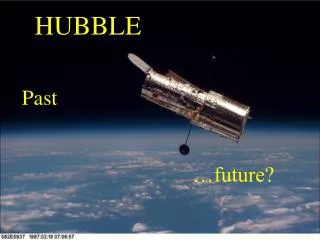

HUBBLE
E N D
Presentation Transcript
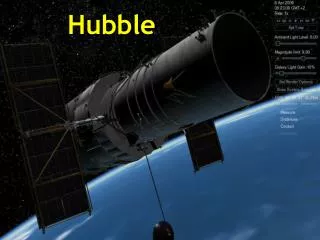
HUBBLE Past …future?
Spitzer Chandra NASA’s Great Observatories “an astronomical Mount Rushmore” Compton Hubble
Gains in orbit • No atmospheric blurring • Wider accessible wavelength range • Instrumental stability • No clouds/daylight (timing)
Some HST Science highlights • Structures of distant galaxies
Some HST Science highlights • Structures of distant galaxies • Hubble constant from Cepheid variable stars
Some HST Science highlights • Structures of distant galaxies • Hubble constant from Cepheid variable stars • Black holes in (almost all) galactic nuclei
Some HST Science highlights • Structures of distant galaxies • Hubble constant from Cepheid variable stars • Black holes in (almost all) galactic nuclei • Protoplanetary material near young stars
Some HST Science highlights • Structures of distant galaxies • Hubble constant from Cepheid variable stars • Black holes in (almost all) galactic nuclei • Protoplanetary material near young stars • Gravitational lenses
Some HST Science highlights • Structures of distant galaxies • Hubble constant from Cepheid variable stars • Black holes in (almost all) galactic nuclei • Protoplanetary material near young stars • Gravitational lenses • Intergalactic gas and its history • Stuff scattered all the way through the textbooks
Instrument history • 1990: FGS HSP FOS GHRS FOC WF/PC • 1993: FGS CoSTAR FOS GHRS FOC WFPC2 • : FGS CoSTAR NICMOS STIS FOC WFPC2 • 2002: FGS CoSTAR NICMOS STIS ACS WFPC2 • 200? COS, WFC3
Hubble status, Sept. 2004 • Space Telescope Imaging Spectrograph dead (only high-res/small-region spectrometer) • 3 of 6 gyros (RSUs) functional (3 needed for full tracking, some observations with 2) • Battery capacity decreasing (will be useless circa 2010) • Estimated 50% failure time on above: 2007 • Instrument/transmitter power cycling now reduced by rescheduling/eliminating parallel imaging
Options • Shuttle SM4 (O’Keefe ruled out, CAIB concerns) • Robotic mission (new tech, some changeouts very risky) • Replace the whole thing (HOP proposal to refly COS/WFC3)
Shuttle? • “Safe haven” would mean standby orbiter • Limited remaining flights earmarked to ISS • Need for independent orbital inspection • Victim of the Vision? • Orbital mechanics: 28.5-degree inclination, getting heaviest payloads highest from Cape Canaveral, restricts options now
Servicing non-options • Prohibitive energy requirements to co-orbit with ISS in reach of astronauts • 28-degree orbit out of reach from Baikonur (ITAR restrictions aside) • Ion thrusters would take the estimated telescope lifetime for orbit change • ~2015 estimated deorbit without boosting
Robotics/teleoperation? • Canadian ISS arm not required yet – “spare” • Some tasks straightforward, actually robotic plus teleoperations mission • Double big/small arm • Robot docking/deorbit committed already • Tests make this look possible • 2-piece spacecraft, Delta/Atlas launch • 2007 a challenge; budget is ballooning • Political aspects re pinning blame
Replace capabilities? • Technology since 1980: lots cheaper. Thin flexible mirrors, lightweight structures, stabilize mirrors rather than structure… • Unique access to optical/UV range • Plan on table to fly 2.4m mirror with existing HST instruments (Hubble Origins Probe or HOP); could be as low as $250M. • Need to decide who gets the instruments!
James Webb Space Telescope • Launch 2011, on Ariane V, to L2 region • 6.5m deployable primary • 0.6-20 microns (far red to mid-IR) • Key problems: formation of galaxies, first stars, maybe planets • Spacecraft weight/mirror area ratio roughly that of Hubble mirror alone!
And at other wavelengths… Chandra and its complement XMM-Newton
Across the spectrum - now FarIR MidIR nearIR opt UV farUV X-ray gamma FUSE INTEGRAL Spitzer GALEX WMAP Hubble Chandra
Intergalactic gas Starburst galaxies High-redshift galaxies Evaporating planets Protoplanetary disks Growth of black holes Complexity of stardeath Gamma-ray bursts Supernova chemistry Quasar jets Stripped galaxies Pregalactic lumps Galaxy history Relativistic jets Multispectral Greatest Hits
A panchromatic view -spiral galaxy M81 ROSAT GALEX Kitt Peak Spitzer VLA
Across the spectrum - soon FarIR MidIR nearIR opt UV farUV X-ray gamma JWST FUSE? INTEGRAL Spitzer Swift GALEX? Planck Hubble? Chandra and XMM SIM TPF? Herschel
A new Universe to explore • The full electromagnetic spectrum • Open international competition for observations • Public data archives (without mailing tapes!) • The beginnings of the Virtual Observatory • But astronomers think about facilities differently from NASA and ESA…