Overview of Older Ethernet Standards: 10Base5 and 10Base2 Technologies
This document provides a comprehensive overview of older Ethernet standards, focusing on 10Base5 and 10Base2 technologies. It discusses the daisy-chain layouts, maximum segment lengths, and technical specifics of these standards, including their hardware requirements like transceivers and connectors. 10Base5 features segments of up to 500 meters, while 10Base2 supports segments of 185 meters. Various repeaters are utilized to connect multiple segments within each standard, ensuring efficient communication across networks. Understanding these standards is essential for appreciating the evolution of networking technologies.

Overview of Older Ethernet Standards: 10Base5 and 10Base2 Technologies
E N D
Presentation Transcript
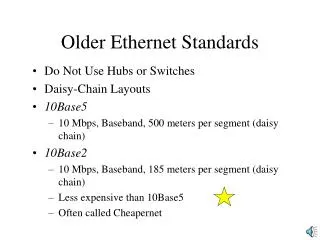
Older Ethernet Standards • Do Not Use Hubs or Switches • Daisy-Chain Layouts • 10Base5 • 10 Mbps, Baseband, 500 meters per segment (daisy chain) • 10Base2 • 10 Mbps, Baseband, 185 meters per segment (daisy chain) • Less expensive than 10Base5 • Often called Cheapernet
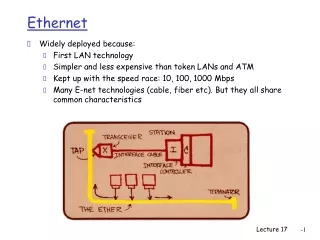
Ethernet 10Base5 Mod C Drop Cable (Attachment Unit Interface or AUI) 15 wires NIC 15-pin AUI Connector N-Connector Trunk Cable Coaxial Cable 500 m maximum Transceiver (Medium Attachment Unit)
Ethernet 10Base5 Mod C 1. Sending NIC Transmits a bit 3. Each Transceiver Sends the bit to Its NIC 2. Transceiver Broadcasts the bit
Ethernet 10Base-5 • Up to 5 segments connected by repeaters • 2,500 meters maximum distance between farthest stations • Four repeaters maximum • No loops among repeaters Repeater Repeater Drop cable 500 m Maximum Segment of Trunk Cable
Ethernet 10Base2 (802.3a) • Cheaper Physical Layer Standard • NICs have twist-on BNC connector • T-connector attaches to NIC • T-connector has BNC connectors for cable runs attaching it to adjacent stations To next NIC To next NIC T-connector BNC NIC
Ethernet 10Base2 (802.3a) • Segments are thin coaxial cable • Run only between NICs • Daisy chain of NICs is a segment • Terminator at end of each segment • Up to 30 stations per segment • 5 segments (4 repeaters) maximum • 10Base2: 185 meters/segment Terminator NIC NIC NIC