The Smallest Stable Fullerene M@C28: Insights into Synthesis and Spectroscopic Studies
10 likes | 131 Vues
The experimental detection of M@C28 fullerene species opens new avenues for spectroscopic research. Utilizing titanium (Ti), a non-toxic metal, enables safe synthesis of these unique structures that are unavailable in their empty-cage form. Fullerenes are significant due to their presence in outer space, where they can serve as markers for the ages of stars and galaxies. This research, supported by several institutions and funding bodies, emphasizes the potential of titanium encapsulation in fabricating the smallest stable fullerenes and furthers our understanding of complex carbon molecular structures.


The Smallest Stable Fullerene M@C28: Insights into Synthesis and Spectroscopic Studies
E N D
Presentation Transcript
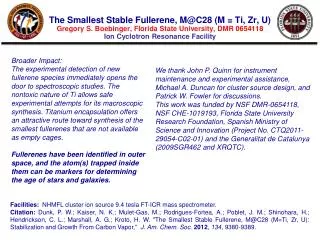
The Smallest Stable Fullerene, M@C28 (M = Ti, Zr, U)Gregory S. Boebinger, Florida State University, DMR 0654118Ion Cyclotron Resonance Facility Broader Impact: The experimental detection of new fullerene species immediately opens the door to spectroscopic studies. The nontoxic nature of Ti allows safe experimental attempts for its macroscopic synthesis. Titanium encapsulation offers an attractive route toward synthesis of the smallest fullerenes that are not available as empty cages. Fullerenes have been identified in outer space, and the atom(s) trapped inside them can be markers for determining the age of stars and galaxies. We thank John P. Quinn for instrument maintenance and experimental assistance, Michael A. Duncan for cluster source design, and Patrick W. Fowler for discussions. This work was funded by NSF DMR-0654118, NSF CHE-1019193, Florida State University Research Foundation, Spanish Ministry of Science and Innovation (Project No. CTQ2011-29054-C02-01) and the Generalitat de Catalunya (2009SGR462 and XRQTC). Facilities: NHMFL cluster ion source 9.4 tesla FT-ICR mass spectrometer. Citation: Dunk, P. W.; Kaiser, N. K.; Mulet-Gas, M.; Rodrigues-Fortea, A.; Poblet, J. M.; Shinohara, H.; Hendrickson, C. L.; Marshall, A. G.; Kroto, H. W. "The Smallest Stable Fullerene, M@C28 (M=Ti, Zr, U): Stabilization and Growth From Carbon Vapor,“ J. Am. Chem. Soc.2012, 134, 9380-9389.