Download
1 / 18
190 likes | 330 Vues
This guide explores the principles of stoichiometry, highlighting the relationships between reactants and products in chemical reactions. Learn how to determine how many cookies you can make with a given number of eggs, calculate limiting reactants, and compute percent yield. Using examples like the reaction of magnesium and oxygen, this resource breaks down the steps for stoichiometric calculations, including writing balanced equations and identifying knowns and unknowns. Perfect for students aiming to understand the foundational concepts of chemistry.

E N D
Stoichiometry Stoichiometric Calculations
A. Proportional Relationships Ratio of eggs to cookies • I have 5 eggs. How many cookies can I make? 2 1/4 c. flour 1 tsp. baking soda 1 tsp. salt 1 c. butter 3/4 c. sugar 3/4 c. brown sugar 1 tsp vanilla extract 2 eggs 2 c. chocolate chips Makes 5 dozen cookies. 5 eggs 5 doz. 2 eggs = 12.5 dozen cookies
A. Proportional Relationships • Stoichiometry • mass relationships between substances in a chemical reaction • based on the mole ratio • Mole Ratio • indicated by coefficients in a balanced equation 2 Mg + O2 2 MgO
B. Stoichiometry Steps 1. Write a balanced equation. 2. Identify known & unknown. 3. Line up conversion factors. • Mole ratio - moles moles • Molar mass - moles grams • Molarity - moles liters soln • Molar volume - moles liters gas • Mole ratio - moles moles Core step in all stoichiometry problems!! 4. Check answer.
C. Molar Volume at STP StandardTemperature&Pressure 0°C and 1 atm 1 mol of a gas=22.4 L at STP
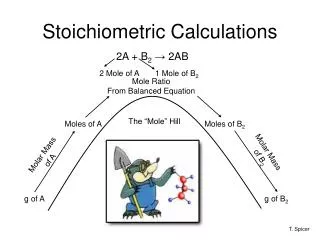
C. Molar Volume at STP LITERS OF GAS AT STP Molar Volume (22.4 L/mol) MASS IN GRAMS NUMBER OF PARTICLES MOLES Molar Mass (g/mol) 6.02 1023 particles/mol Molarity (mol/L) LITERS OF SOLUTION
Stoichiometry II. Stoichiometry in the Real World
A. Limiting Reactants • Available Ingredients • 4 slices of bread • 1 jar of peanut butter • 1/2 jar of jelly • Limiting Reactant • bread • Excess Reactants • peanut butter and jelly
A. Limiting Reactants • Limiting Reactant • used up in a reaction • determines the amount of product • Excess Reactant • added to ensure that the other reactant is completely used up • cheaper & easier to recycle
A. Limiting Reactants 1. Write a balanced equation. 2. For each reactant, calculate the amount of product formed. 3. Smaller answer indicates: • limiting reactant • amount of product
A. Limiting Reactants • 79.1 g of zinc react with 0.90 L of 2.5M HCl. Identify the limiting and excess reactants. How many liters of hydrogen are formed at STP? Zn + 2HCl ZnCl2 + H2 ? L 79.1 g 0.90 L 2.5M
A. Limiting Reactants Zn + 2HCl ZnCl2 + H2 ? L 79.1 g 0.90 L 2.5M 79.1 g Zn 1 mol Zn 65.39 g Zn 1 mol H2 1 mol Zn 22.4 L H2 1 mol H2 = 27.1 L H2
A. Limiting Reactants Zn + 2HCl ZnCl2 + H2 ? L 79.1 g 0.90 L 2.5M 0.90 L 2.5 mol HCl 1 L 1 mol H2 2 mol HCl 22.4 L H2 1 mol H2 = 25 L H2
A. Limiting Reactants left over zinc Zn: 27.1 L H2 HCl: 25 L H2 Limiting reactant: HCl Excess reactant: Zn Product Formed: 25 L H2
B. Percent Yield measured in lab calculated on paper
B. Percent Yield • When 45.8 g of K2CO3 react with excess HCl, 46.3 g of KCl are formed. Calculate the theoretical and % yields of KCl. K2CO3 + 2HCl 2KCl + H2O + CO2 45.8 g ? g actual: 46.3 g
B. Percent Yield K2CO3 + 2HCl 2KCl + H2O + CO2 Theoretical Yield: 45.8 g ? g actual: 46.3 g 45.8 g K2CO3 1 mol K2CO3 138.21 g K2CO3 2 mol KCl 1 mol K2CO3 74.55 g KCl 1 mol KCl = 49.4 g KCl
B. Percent Yield 46.3 g 49.4 g K2CO3 + 2HCl 2KCl + H2O + CO2 Theoretical Yield = 49.4 g KCl 45.8 g 49.4 g actual: 46.3 g 100 = 93.7% % Yield =