Download
1 / 42
420 likes | 530 Vues
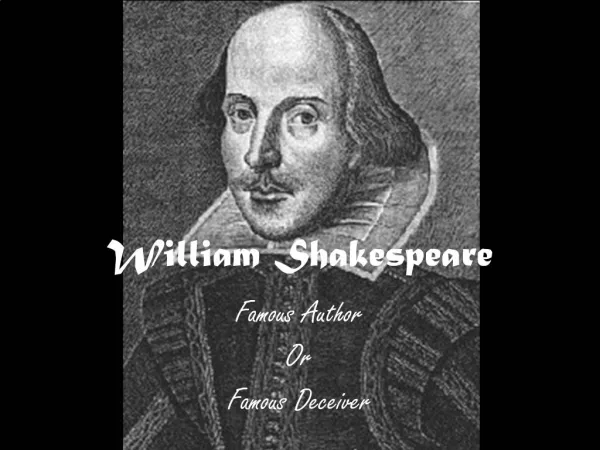
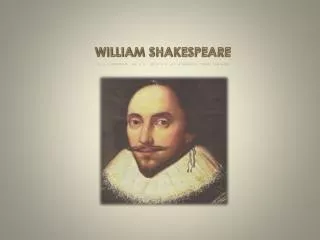
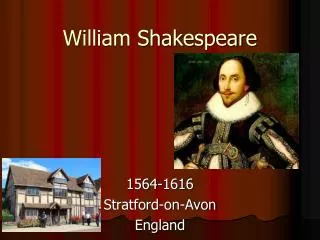
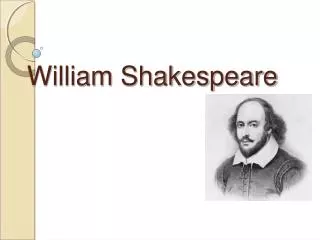
William Shakespeare, born on April 23, 1564, in Stratford-upon-Avon, was a prolific playwright and poet whose influence on English literature is undeniable. He penned 37 plays, including the iconic "Romeo and Juliet." Shakespeare's extensive vocabulary, innovative use of language, and complex characterizations contributed to his lasting legacy. His works delve into universal themes and emotions, making them relevant even today. His theater, the Globe, hosted many of these productions and showcased the vibrant culture of Elizabethan England. Explore the brilliance of Shakespeare!

E N D
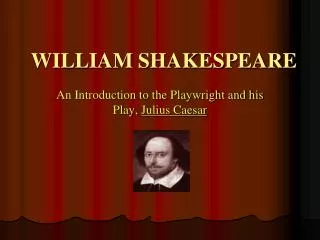
William Shakespeare The Man, His Writing Style, His Theater Oh, and Romeo & Juliet, too
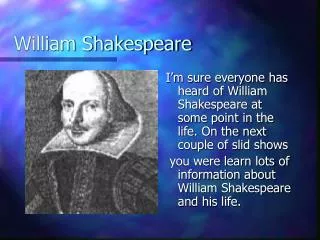
I. A little about Will… • Born April 23, 1564 (we think) • Lived in Stratford-Upon-Avon, a small town NW of London • Attended school, studied Latin and literature • Married Anne Hathaway at age 18 (she was 26) • Daughter born in 1583, twins (one of each) born in 1585
More about Will… • Was successful playwright in London by 1592 • Wrote 37 plays • Romeo and Juliet written in 1594 • Owned part of the Globe Theater and The King’s Men acting troupe • Died April 23, 1616 (his birthday) • Buried in Holy Trinity Church
Shakespeare’s Grave The slab over his grave reads: Good Friend, for Jesus’ sake forbearTo dig the dust enclosed here:Blessed be the man that spares these stones,And curst be he that moves my bones.
So why do we bother reading him? • Huge contribution to the English language • His vocabulary was 30,000 words (average person is 15,000 words) • 1/10 of the words he used had never been used before – this means he gave us 3,000 words! • Popular culture – his plays are constantly turned into movies = $$$ • Universal themes & rich characters that still work today
Quoting Shakespeare • If you’ve ever said any of the following, you speak Shakespeare already: Forever and a day (As You Like It) Flesh and blood, make your hair stand on end (Hamlet) The devil incarnate (Henry V) Dead as a doornail (Henry VI) Charmed life (Macbeth) All that glitters is not gold (Merchant of Venice)
The Epic Poems • We know Shakespeare wrote two • The Rape of Lucrece • Venus and Adonis • Others exist, but their authorship is in question
The Sonnets • He wrote 154 of these • No titles; identified by number or the first line • Sonnets were THE way to express your love to your girl; young men also wrote them to entertain each other.
The Plays • Histories • Plays about historical events • Richard II, Henry VIII • Comedies • Plays that have happy endings • Taming of the Shrew, As You Like It • Tragedies • Plays that have unhappy endings • Macbeth, Julius Caesar
Tragedy • Drama where the central character/s suffer disaster or great misfortune • Downfall may be the result of • Fate • Fatal character flaw • A combo of the two
II. Writing Style • The Sonnets • Follow very strict form • Fourteen lines • Three quatrains • One couplet • Iambic pentameter • Rhyme Scheme ABAB CDCD EFEF GG
Iambic Pentameter • One unstressed syllable followed by a stressed syllable • Iamb = U / such as pretend, annoy • When a line has 5 iambs, it is in iambic pentameter • Penta = 5; meter = rhythmic unit • But SOFT what LIGHT through YONder WINdow BREAKS?
The Sonnets • Three quatrains • Qua = 4, so three groups of four lines each • Main idea introduced and expanded • Couplet • Two, a “couple” of lines • Signals a “turn” in the meaning of the poem
Sonnet 18 • Look at rhyme scheme • Watch the main idea develop • The turn (couplet) at the end
Romeo & Juliet • Written in blank verse • Unrhymed iambic pentameter • Parts are written in prose • Ordinary writing that is not poetry or song • Characters of the lower social classes spoke in prose in Shakespeare’s plays • Why do you suppose that is?
Why is it so hard to read? • Gigantic vocabulary • Weird syntax (word order) • We say: The cow jumped over the moon. • He says: Over the moon jumped the cow. • We say: Why do you call for a sword? • He says: Why call you for a sword? • Words change in meaning over time • Soft used to mean “wait a minute” • Nice used to mean “stupid”
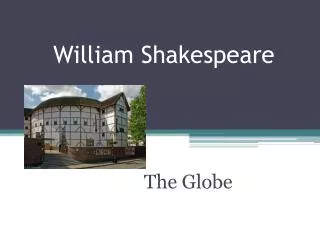
III. His Theater: The Globe • Opened in 1599 • Cost: 2 pennies to sit on a wooden bench, 1 penny to stand on ground in the pit • Plays produced for the general public • Roofless, open air theater with no restrooms
Theater Design • A flag would fly to signify performances • Stage was raised so audience members could not join in fight/battle scenes • Trap door in bottom of stage – characters from hell. • Second level gallery, upper stage (balcony scene in R&J)
Much Different from Today! • Plays could only be presented during daylight hours – no lighting! • No scenery • Very elaborate costumes • Male actors only – even for female roles • Audience members were active – yelling, throwing food on stage, etc.
The Globe’s History • Burned down in 1613 during a performance of Henry VIII when a cannon fired and ignited the thatch roof. It was burned to the ground in an hour. • Was rebuilt with a tile roof. • The Puritans closed all theaters in 1642 • Globe was torn down in 1644. • Has been rebuilt in London and you can see performances there today.
Acting Profession • Repertory theater • Several plays running at the same time • Actors had to know more than one part • Several skills required • Singing • Playing instruments • Dancing • Fencing
Theater Terminology • Pit – uncovered courtyard in front of the stage • Groundlings – people who paid 1 penny to stand in the pit and watch the play • Galleries – areas of seating for wealthy • Tiring House – area behind stage used for dressing rooms and storage
IV. Romeo and Juliet • One of Shakespeare’s most popular plays, along with Hamlet and Richard III • Story came from a poem by Arthur Brooke titled “The Tragicall Historye of Romeus and Juliet” • First published in 1562, two years before Shakespeare’s birth • Reprinted in 1587
Romeo & Juliet • Story also from Greek mythology – Pyramus and Thisbe • “…they would have married, but their parents forbade it” (Humphries 83). • “…they would fool their guardians…come outdoors, run away from home, and even leave the city” (83). • A lion scares Thisbe off and she drops her veil. Pyramus, seeing the bloody veil, kills himself thinking Thisbe is dead. • So Thisbe “…fell forward on the blade, still warm and reeking with her lover’s blood” (86).
Romeo & Juliet • Explores the effects of fate, secrecy, revenge, tragedy and love at first sight • THEMES (insight about life or human nature): • There are forces in life over which people have no control (fate) • Even well intended deceptions and secrets can be destructive • Revenge can destroy the avenger and victim
Dramatic Terms • You will need to know the following terms before we begin our study of the play: Flat character, comic relief, dramatic foil, pun, metaphorical language, dramatic irony, situational irony, verbal irony, direct address, aside, soliloquy, monologue.
Flat Character • One dimensional, embodying a single trait • Often used by Shakespeare in a tragedy to provide comic relief
Comic Relief • Use of comedy in literature that is NOT comedy to provide “relief” from the seriousness or sadness of the story. • Creates an emotional rollercoaster that deepens tragic feelings in audience
Dramatic Foil • A character whose traits contrast with and highlight those of another character • Benvolio to Tybalt • Look for other examples in the play
Puns • Humorous use of a word with two meanings • Shakespeare loved to use these but we often miss them due to the Elizabethan language.
Metaphorical Language • Comparison of two unlike things to describe one of those things • “Sweet flower, with flowers thy bridal bed I strew” Paris standing over Juliet’s “lifeless” body
Dramatic Irony • A contradiction between what a character thinks and what the reader/audience knows to be true • We know Juliet is not really dead • Romeo believes she is really dead • Dramatic irony is created when he sees her in the tomb and kills himself
Situational Irony • An event occurs that directly contradicts the expectations of the character, reader or audience • For example, a fire house burning down • R&J do end up together forever, just not alive
Verbal Irony • Words are used to suggest the opposite of what is meant • In the Prologue the families are described as “Alike in dignity” but we soon realize they do not behave with dignity; thus, they are similarly undignified
Direct Address • Words that tell the reader who is being addressed • “A right fair mark, fair coz, is soonest hit.” • “Ah, my mistresses, which of you all/Will now deny to dance?”
Aside • Words spoken in an undertone, not intended to be heard by all characters • Used to let the audience in on the character’s thoughts in the moment
Monologue • One person speaking on stage, others may be present as well • Lengthy speech • Mercutio’s Queen Mab speech • Prince of Verona commanding the families to cease feuding
Soliloquy • Long speech expressing thoughts of a character • That character is alone on stage
The End! Keep these notes in your R&J folder (formerly your short story unit folder!)