
SlideServe
Menu
Préférences
© SlideServe · v2026

The Real Number System

mayda avatar
16 diapositives · 2.2K Views · Feb 12, 2012

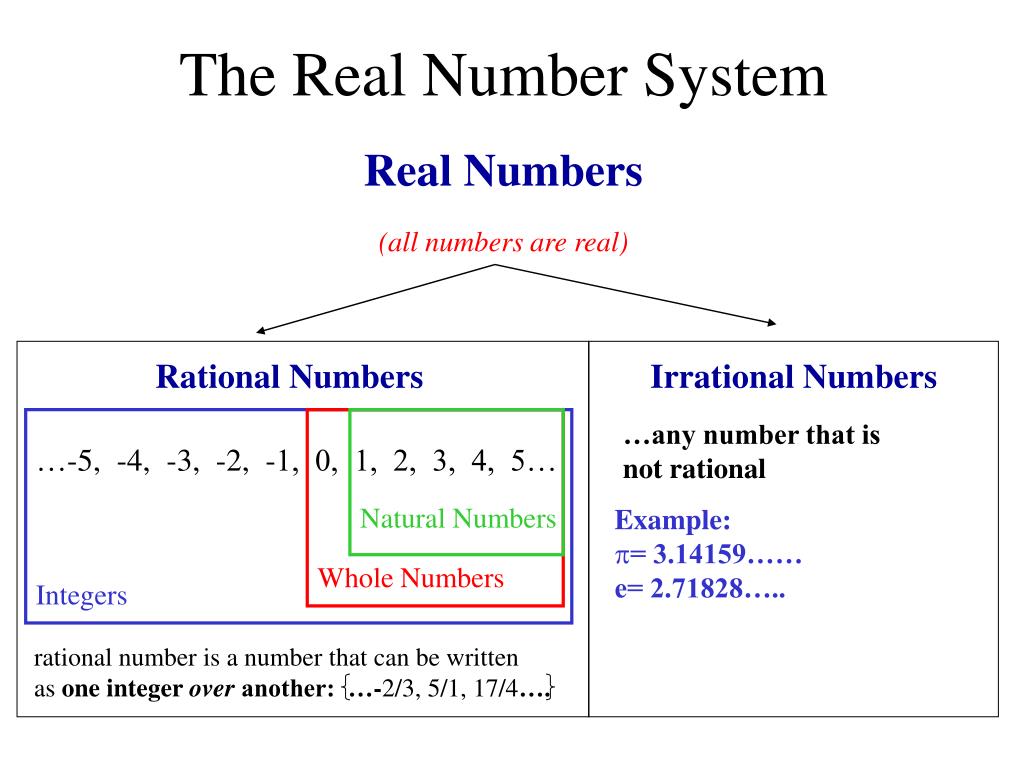
The Real Number System. Rational Numbers. Irrational Numbers. Real Numbers (all numbers are real). …any number that is not rational. …-5, -4, -3, -2, -1, 0, 1, 2, 3, 4, 5…. Natural Numbers. Example: = 3.14159…… e= 2.71828….. . Whole Numbers. Integers.
The Real Number System - slide 1
01 / 16The Real Number System
1 / 17

Télécharger la présentation

The Real Number System
Une image / un lien ci-dessous est fourni (tel quel) pour télécharger la présentation

Politique de téléchargement : le contenu du site vous est fourni TEL QUEL pour votre information et votre usage personnel ; il ne peut être vendu, concédé sous licence ni partagé sur d’autres sites sans l’accord de son auteur.Le contenu vous est fourni TEL QUEL, pour votre information et votre usage personnel uniquement. Téléchargez la présentation en cliquant sur ce lien. Lors du téléchargement, si vous ne parvenez pas à télécharger une présentation, l’éditeur a peut-être supprimé le fichier de son serveur.Pendant le téléchargement, si vous ne parvenez pas à obtenir une présentation, le fichier a peut-être été supprimé par l’éditeur.

F I N

Plus de contenu associé

Transcription de la présentation
  1. The Real Number System Rational Numbers Irrational Numbers Real Numbers (all numbers are real) …any number that is not rational …-5, -4, -3, -2, -1, 0, 1, 2, 3, 4, 5… Natural Numbers • Example: • = 3.14159…… e= 2.71828….. Whole Numbers Integers rational number is a number that can be written as one integer over another: …-2/3, 5/1, 17/4….

  2. Inequality notation Read left to right … a<ba is lessthanba<b  a is less than or equal to ba >ba is greater thanba >b  a is greater than or equal to b a = b  a is not equal to b

  3. The Real Number Line Any real number corresponds to a point on the real number line. Order Property for Real Numbers Given any two real numbers a and b, - if a is to the left of b on the number line, then a < b. - if a is to the right of b on the number line, then a > b.

  4. Basic Properties of Real Numbers Did you ever notice when you perform SOME arithmetic operations the order which you perform them does not affect the answer? Example • Add: 4 + 3 = • Add: 3 + 4 = Commutative Property of Addition & Multiplication • Multiply: 4 x 3 = • Multiply: 3 x 4 = a + b = b + a a x b = b x a Think: Does this property apply to subtraction and division. Give an Example!

  5. Basic Properties of Real Numbers 2 x ( 4 + 3 ) = 2 x ( 7 ) = 14 Consider the following example solved in two ways: 2 x ( 4 + 3 ) = 2 x 4+2 x 3= 8 + 6 = 14 Same result Distributive Property of Real Numbers a (b + c) = ab+ac a (b – c ) = ab–ac

  6. Absolute Value of a Number • The absolute valueof x, notated | x |, measures theDISTANCEthat x is away from the origin(0) on the real number line.  Example: absolute value of 3

  7. is the reciprocal of 3 Clearly 3 is the reciprocal of The Reciprocal of a Number One number is the reciprocal of another if their product is 1. In general: The reciprocal of a fraction is obtained by interchanging the numerator and the denominator, i.e. by inverting the fraction. Example: The reciprocal of is

  8. Absolute Value of a Number Note:Distance is always going to be positive(unless it is0) whether the number you are taking the absolute value of is positive or negative. Example: absolute value of - 3

  9. Wrap up - Objectives • Identify what numbers belong to the set of • natural numbers, whole numbers, integers, rational numbers, • irrational numbers, and real numbers.  • Use the Order Property for Real Numbers. • Find the absolute value of a number.  • Write a mathematical statement with an equal sign or an • inequality. • Know and understand scientific notation.

  10. Fractions • A numeric FRACTION is a quotient of two numbers.  Numerator , denominator = 0 Fraction = Denominator Fraction Improper Fraction Proper Fraction Numerator is smaller than denominator Numerator is larger than denominator

  11. Fractions • Mixed numbers expression consisting of a whole number and a proper fraction: Convert mixed number to improper fraction: • Equivalent fractions fractions that represent the same number are called equivalent fractions.

  12. Fractions Reducing fractions Steps: • List the prime factors of the numerator and denominator. • Find the factors common to both the numerator and denominator and divide the numerator and denominator by all common factors (called canceling). • Reduce to the lowest terms. Example: Reduce to the lowest terms. Step 1 Step 2 Step 3

  13. Fractions • LCD – Least common denominator of two fractions: is the smallest number that can be divided by both denominators. Note: we need to find the LCD before we add or subtract two fractions. LCD of 3 and 5 = 15 (smallest number that can be divided by both 3 and 5)

  14. the factors here are 2 and 3 LCD = Fractions Find LCD and add the fractions 1. We write each denominator as a product of its prime factors. 1. 2. LCD = product of all factors taken at the biggest power

  15. Fractions • Write a fraction as a decimal: use a calculator to divide numerator by the denominator. If the division comes to an end , the decimal is a terminating decimal, if the division never ends the decimal is a repeating decimal. 1.Terminating decimal : 2. Repeating decimal: • Write a fraction as a percent: • A percent is a ratio of a number to 100. Percent means "per hundred." Thus, 20 • percent, or 20%, means . Fraction Decimal Percent x 100 = =

  16. Wrap up - Objectives • Know what the numerator and denominator of a fraction are. • Simplify a fraction. • Find the least common denominator of given fractions. • Multiply, divide, add and subtract fractions. • Write a fraction in decimal form and as a percent. • Know how to do percent increase and percent decrease word problems