Download
1 / 13
130 likes | 259 Vues
The ISOLDE decay station incorporates multiple advanced detectors for measuring radioactive decay, including high-purity Germanium detectors (Clover and Miniball), LaBr3 scintillators, and plastic detectors. While Germanium detectors offer high energy resolution, they have low response times; conversely, scintillators provide faster responses but generate more noise. A tape station mitigates noise from decay products using Mylar tape to cycle them to a lead-protected bin. Future applications include stress analysis to improve equipment alignment and performance in radioactive measurements.

E N D
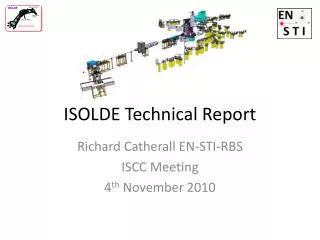
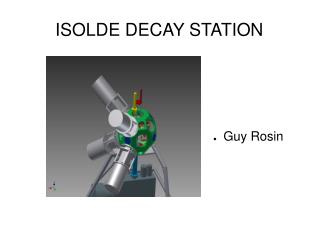
ISOLDE DECAY STATION • Guy Rosin
Detector Setup • The Decay station contains several detectors to measure radioactive decay, as of now , • the high purity Germaniums • detectors (Clover • and Miniball), • LaRB3 Scintillators • and plastic detectors
Detector setup • Gr Detectors have high energy resolution, but low response time (~microseconds), Scintillators have high response time (~nanoseconds), but more noise. The HPGs are used to distinguish events from noise and the scintillators are then used to get a more accurate of gamma decays.
0 0 , 8 5968,66 8 65,00 7 3 8 , 3 6 6 7 9 1 , 1 7 2 9 4 , 7 0 4 3 , 0 8 6 4 5 3 775,03 1682,72 10000,00
Deflector Diagnostic box -calorimeter -Faraday cup Quadrupole focusing
Tape Station • Tape Station is used to remove the noise from the decay products. Products of radioactive decay still emit radiation which interferes with the detectors, so the tape removes the decay products from the detector configuration. The decay products are implemented in the Mylar tape and cycled down to the lead protected bin.
Stress Test • Future uses, One of the things the CAD drawing might be used for is a stress analysis. A stress analysis shows the net force on the objects in the model (usually from gravity). The equipment usually sags • under its own weight which • causes error in the alignment. • Stress test can be used • to calculate in advance • corrections in the equipment
Shell Model • The most stable nuclei have filled up a proton or neutron shell. The “magic numbers” of stability correspond to a full shell.