Download
1 / 10
100 likes | 217 Vues
Dive into the essential questions posed in Harper Lee's "To Kill a Mockingbird," exploring the sources, symptoms, and consequences of prejudice. This analysis highlights the significance of empathy in achieving maturity and how it aids in combating discrimination. Set in the backdrop of 1930s Maycomb, Alabama, the novel emphasizes the role of informal experiences in education while addressing enduring themes such as courage and moral integrity. Discover how the structure of the novel reflects these powerful motifs and the author's message on understanding others.

E N D
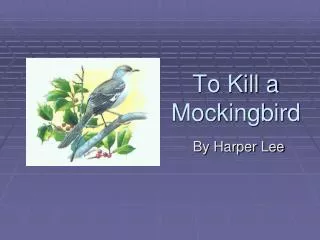
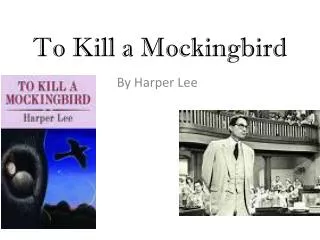
Introduction to To Kill A Mockingbird By Harper Lee
Essential Questions ·What are the sources, symptoms, and consequences of prejudice? ·What is empathy? What role does developing the capacity to empathize play in achieving maturity? • How does the ability to empathize help combat and overcome prejudice? • What role do our informal experiences play in our education?
About the Author: Harper Lee • To Kill A Mockingbird was published in 1960. • It is Harper Lee’s first and only novel • It received the Pulitzer Prize in 1961. • AFI ranks the film which is based on the book as on of the greatest American films of all time (number 34 on the list)
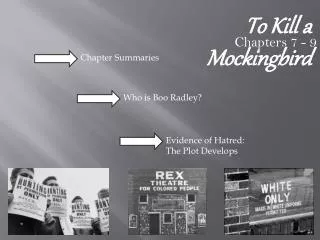
Setting • The novel is set in Maycomb, Alabama during the Great Depression (1930’s) • H.Lee grew up and still lives in Monroeville, AL • Maycomb is based on Monroeville.
What do you know about the setting? Consider the economic, social, and regional implications.
Themes and Related Motifs • Definitions: Theme and Motif • Theme – a message the author is trying to send through a work of literature • Motif- a recurring element
Prejudice- learning how to judge in a reasonable fashion MOTIFS - blind spots, mockingbirds and “standing in someone else’s shoes” Themes and Motifs cont.
Empathy – learning to look beyond one’s self and consider another’s perspective; gaining maturity MOTIFS- education (formal and informal), “standing in someone else’s shoes" Themes and Motifs cont.
Courage – learning how, when and what to fight MOTIFS – heroism, weapons, losing battles, fear, integrity vs. hypocrisy Themes and Motifs cont.
Structure Structure – The novel is divided into 2 parts The two parts of the novel are parallel (similar in style and structure) Part 1 Part 2