Exploring Implicit Differentiation and Chain Rule Applications
This guide focuses on implicit differentiation, specifically when dealing with equations where y is a function of x. We provide examples to illustrate how to differentiate implicitly, ensuring proper application of the chain rule. The process involves differentiating both sides of the equation, isolating terms with derivatives, and solving for dy/dx. Additionally, we discuss topics such as logarithmic differentiation and finding tangent lines to curves. By using these techniques, we can effectively handle complex functions and equations.

Exploring Implicit Differentiation and Chain Rule Applications
E N D
Presentation Transcript
Example If f(x) = (x7 + 3x5 – 2x2)10, determine f ’(x). Answer:f΄(x)=10(x7 + 3x5 – 2x2)9(7x6 + 15x4 – 4x) Now write the answer above only in terms of y if y = (x7 + 3x5 – 2x2). Answer:f ΄(x)=10y9y΄
Try it If y is some unknown function of x, then
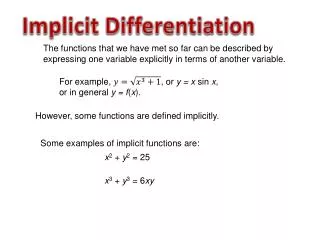
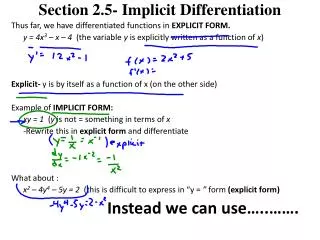
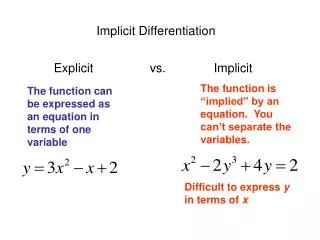
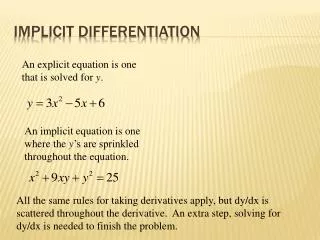
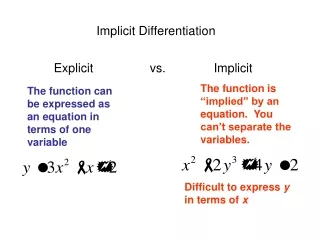
Purpose 9x + x2– 2y = 5 5x – 3xy + y2 = 2y Easy to solve for y and differentiate Not easy to solve for y and differentiate In equations like 5x – 3xy + y2 = 2y, we simply assume that y = f(x), or some function of x which is not easy to find. Process wise, simply take the derivative of each side of the equation with respect to x and when we encounter terms containing y, we use the chain rule.
Example 1 y3 = 2x Solving for y’, we have the derivative
Example 2 x2y3 = -7 Solving for y’, we have
Implicit Differentiation • Differentiate both sides of the equation: Since y is a function of x, every time we differentiate a term containing y, we need to multiply it by y’or dy/dx • Solve for y’: • Every term containing y’ should be moved to the left by adding or subtracting terms only. • Every term containing no y’ should be moved to the right hand side. • Factor out y’ and divide both sides by the expression inside ( ).
Examples Determine dy/dx for the following.
Examples Find the equation of tangent line to the curve
Examples Determine the first derivative of each of the following.
Logarithmic Differentiation • Take the natural logarithms of both sides of an equation y = f(x). • Use the laws of logarithms to expand the expression. • Differentiate implicitly with respect to x. • Solve the resulting equation for y′.
Examples Find the equation of tangent line to the curve