Understanding Symmetry: Lines and Transformations in Regular and Irregular Polygons
210 likes | 316 Vues
This guide explores the concepts of symmetry in polygons, focusing on regular and irregular shapes. We discuss lines of symmetry, explaining that regular polygons have as many lines of symmetry as edges, while irregular polygons can also possess them. The importance of shapes such as rectangles, hexagons, pentagons, and others is emphasized. Through exercises involving rotation and reflection, learners will understand how to manipulate shapes in different quadrants, proving their understanding of symmetry and transformations.


Understanding Symmetry: Lines and Transformations in Regular and Irregular Polygons
E N D
Presentation Transcript
SYMMETRY SYMMETRY
REGULAR IRREGULAR
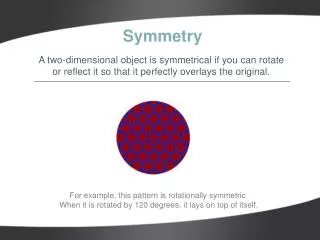
Lines of Symmetry TRUE? FALSE? Q. The number of lines of symmetry of a regular polygon is always the same as the number of edges. TRUE? FALSE? Q. Irregular polygons have no lines of symmetry
Lines of Symmetry Regular or Irregular? Hexagon
How many lines of Symmetry? Regular or Irregular? Hexagon
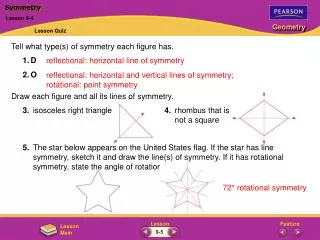
TRUE 1. Regular polygons have the same numbers of lines of symmetry as the number of sides or edges. 2. Irregular polygons can have lines of symmetry.
RECTANGLE HEXAGON OCTAGON PENTAGON TRIANGLE TRAPEZIUM PARALLELOGRAM
ROTATION REFLECTION REFLECTION
ROTATION AND REFLECTION EXERCISE • Plot and draw (1,2) (2,2) (1,4) • Rotate shape 90 degrees clockwise around point (1,2) • Reflect both shapes in all 3 quadrants • Plot and draw (-3,1) (-2,1) (-3,3) (-1,3) • Rotate shape 90 degrees clockwise around point (-3,3) • Reflect both shapes in all 3 quadrants
Rotation 270 degrees180 degrees or 90 degrees? Clockwise or Anticlockwise?
Rotation 270 degrees180 degrees or 90 degrees? Clockwise or Anticlockwise?
Rotation 270 degrees180 degrees or 90 degrees? Clockwise or Anticlockwise?
Rotation 270 degrees180 degrees or 90 degrees? Clockwise or Anticlockwise?