Download
1 / 1
10 likes | 132 Vues
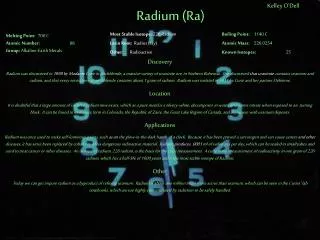
Radium-226, discovered in 1898 by Madame Curie in pitchblende, is the most stable isotope of radium and has a half-life of 1600 years. Curie's groundbreaking work identified radium in uranium ore, highlighting its rarity—approximately 1 gram per 7 tons of pitchblende. Isolated in 1911, radium is known for its silvery-white appearance and dangerous radioactivity, previously used in self-luminous paints. However, due to its carcinogenic properties, it has been replaced by safer alternatives. Today, radium is encountered mainly as an impurity in uranium refinement.

E N D
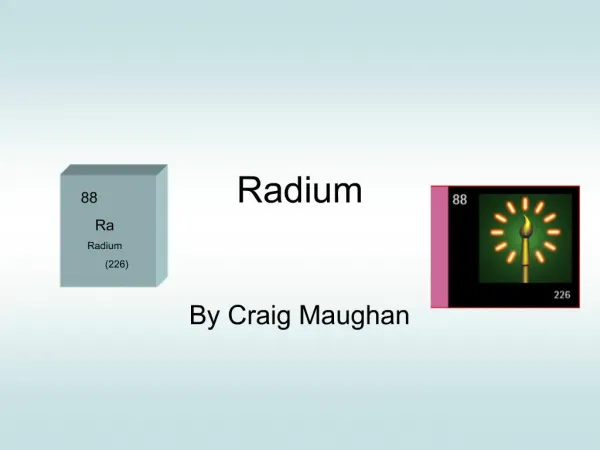
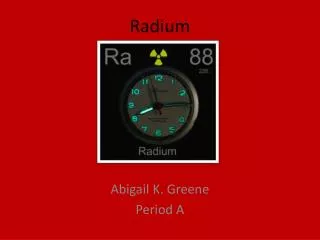
Kelley O’Dell Most Stable Isotope: 226 Radium Latin Root: Radius (ray) Other: Radioactive Boiling Point: 1140 C Atomic Mass: 226.0254 Known Isotopes: 25 Radium (Ra) Discovery Radium was discovered in 1898 by Madame Curie in pitchblende, a massive variety of uraninite ore, in Nothern Bohemia. She discovered that uraninite contains uranium and radium, and that every seven tons of pitchblende contains about 1 gram of radium. Radium was isolated in 1911 by Curie and her partner Debierne. Location It is doubtful that a large amount of isolated radium now exists, which as a pure metal is a silvery-white, decomposes in water, and forms nitrate when exposed to air, turning black. It can be found in its impure form in Colorado, the Republic of Zaire, the Great Lake Region of Canada, and anywhere with uranium deposits. Applications Radium was once used to make self-luminous paints, such as on the glow-in-the-dark hands of a clock. Because it has been proved a carcinogen and can cause cancer and other diseases, it has since been replaced by cobalt 60, a less dangerous radioactive material. Radium produces .0001 ml of radon gas per day, which can be sealed in small tubes and used to treat cancer or other diseases. An isotope of radium, 226 radium, is the basis for the curie measurement. A curie is the measurement of radioactivity in one gram of 226 radium, which has a half-life of 1600 years and is the most stable isotope of Radium. Other Today we can get impure radium as a byproduct of refining uranium. Radium is about one million times more active than uranium, which can be seen in the Curies’ lab notebooks, which are too highly contaminated by radiation to be safely handled. Melting Point: 700 C Atomic Number: 88 Group: Alkaline-Earth Metals