Indus River Valley
Indus River Valley. Classical Indian Civilization. Began in the Indus River Valley Spread into the Ganges River Valley Then spread through the Indian subcontinent. Geography.


Indus River Valley
E N D
Presentation Transcript
Classical Indian Civilization • Began in the Indus River Valley • Spread into the Ganges River Valley • Then spread through the Indian subcontinent
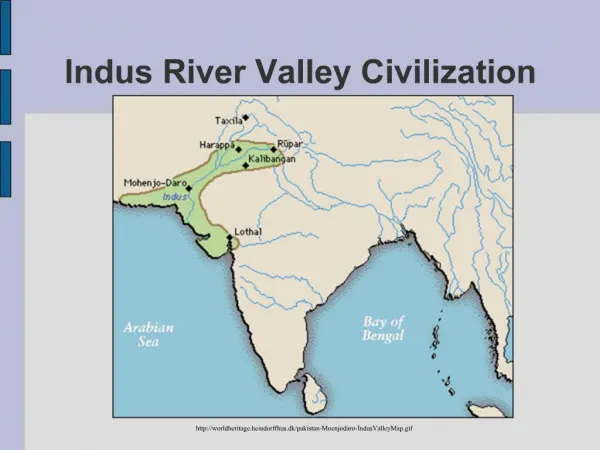
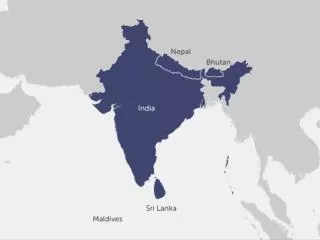
Geography • The Indian civilization was protected from invaders by the physical barriers of the Hindu Kush and Himalayan Mountains and by the Indian Ocean
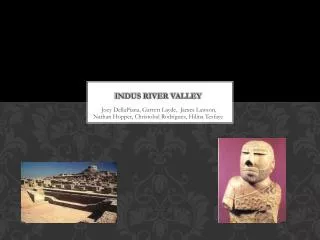
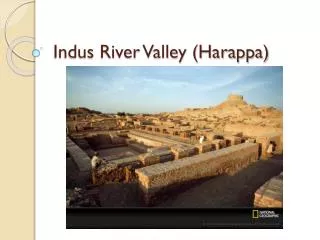
Harappan Civilization • Arose around 2500 BC and lasted until 1700 BC • Major cities were Harappa and MohenjoDaro built around a citadel
Indo-Aryan People • Invaded the area around 1750 BC • Came from north of the Black and Caspian Seas
Caste System • A form of social organization introduced by the Indo-Aryans • Based on occupations
Four levels of the caste system • At the top – rulers and warriors • Next, Brahmins – the priests and scholars • Then – the merchants, traders, and farmers • Last – the peasants who worked the fields owned by others
Government • Tribes forms small city-states • Each state ruled by raja and his council
Social Life • Complex system of social orders • Elaborate rules governed marriage among the difference orders • Parent-arranged marriage favored • Marriage by purchase, by capture, and by mutual consent recognized
Economy • Mostly farmers • Wheat and barley major crops • Poor transportation and trading methods sometimes limited trade • System of barter for goods
Mauryan Empire – Asoka • Continued political unification of much of India • Contributions: Spread of Buddhism, free hospitals, veterinary clinics, good roads
Gupta Empire • Golden Age of classical Indian culture • Contributions: Mathematics (concept of zero), medical advances (setting bones), astronomy (concept of a round earth), new textiles, literature
Hinduism • Developed by the Indo-Aryans • The Vedas are the sacred Hindu texts • Became India’s major religion • Belief in many forms of one major deity • Reincarnation: cycles of rebirths
Dharma – means doing one’s moral duty in this life so that the soul can advance in the next • Karma: the good or bad force created by a person’s actions. Future reincarnation based on present behavior • Nirvana: a perfect peace; the goal of all Hindus – unite with Brahman • Vedas and Upanishads – sacred writings
A way of life rather than strictly defined rules • Everyone has to find his or her own way to god • When a person dies, the soul does not die, but reborn in another form – not necessarily human
How one behaves in one life affects the next life • Belief in a caste system in which a person is born into a set position and cannot change in present life • Belief in religious tolerance