Download
1 / 1
10 likes | 126 Vues
This study explores Foot-and-Mouth Disease (FMD) control strategies using contact network simulations. Conducted by Darren M. Green, Istvan Z. Kiss, and Rowland R. Kao from the University of Oxford, the research investigates different network structures—clustered and random—impacting epidemic dynamics. We analyze epidemic trees derived from simulated outbreaks and compare them with historical data from the UK in 2001. Our findings highlight the importance of culling levels on epidemic spread, providing insight for future FMD management strategies.

E N D
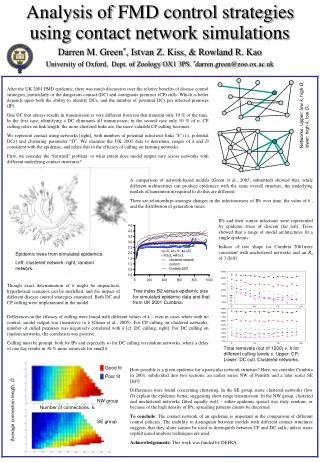
Analysis of FMD control strategies using contact network simulations Darren M. Green*, Istvan Z. Kiss, & Rowland R. Kao University of Oxford, Dept. of Zoology OX1 3PS. *darren.green@zoo.ox.ac.uk Networks. Upper: low k, high D;lower: high k, low D. Epidemic trees from simulated epidemics. Left: clustered network: right, random network. Tree index B2 versus epidemic size for simulated epidemic data and that from UK 2001 Cumbria. Total removals (out of 1000) v.k for different culling levels c. Upper: CP; Lower: DC cull. Clustered networks. █ Good fit █Poor fit Average connection length, D. NW group Number of connections, k. SE group