Empowering Inclusion: Accessibility in Computing
Expanding understanding of accessibility in computing, from assistive technology to social impact, benefits, evolution, and criticisms. Explore how inclusive design can enhance usability for all users.

Empowering Inclusion: Accessibility in Computing
E N D
Presentation Transcript
Accessibility Computing @ CMU Ranny Zhao Dahiana Jimenez Adrian Lopez
Accessibility definition • Describes the degree to which a product is accessible by as many people as possible. • Often used to focus on people with disabilities and their right of access to entities - usually through use of assistive technology. • Accessibility is not to be confused with usability • the extent to which a product/device can be used by specified users to achieve specified goals with effectiveness in a specified context of use.
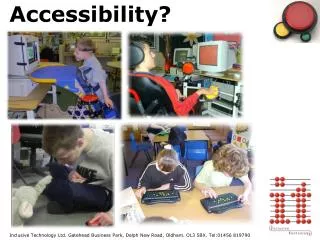
Assistive technology (at) • Includes adaptive devices for people with disabilities. • The Technology-Related Assistance for Individuals with Disabilities Act of 1988 • AT promotes greater independence by enabling people to perform tasks that they were formerly unable to accomplish.
Benefits • Conduct business • Interact with family and friends • Manage health • Independence • 54 million people nationwide rely on AT daily to improve their quality of life • Children/schools • Elderly • Athletes
Earlier Evolutions • Visionary • Braille • 1821 by Louis Braille • Glasses • Contacts • Immobility • Canes • Manual Wheelchairs • Elevators • Escalators • 1800s
Positive Aspects • Illness or disability • Vision problems • Simple • change font size and color for better visibility • alternative keyboards • scanner and reading software • Limited dexterity • voice recognition • hands free • Alternative input devices • Cognitive problems • Electronic reminders • Personal Digital Assistants (SMS) • Programmable keys
Positive Aspects • Now • Electronic Wheelchairs • Public busses accessibility • Through electronic ramps • Drivers with Wheelchair Dependency • Independent access to personal car • Enclosed carrier attached to car • Economic Benefit
Criticisms • Criticisms • Accessibility • Integration into typical operating systems • Voice control/read out loud (Microsoft) • Affordability • Improvement of technology • Cheaper prices • Loans of equipment/ technology • Government assistance
Our Opinion • Technology is often created without regard to people with disabilities. • Similar Interests as nondisabled • Growth of Assistive Technology • Think Broader