Download
1 / 5
60 likes | 253 Vues
This guide explains how to solve quadratic equations of the form ax² + bx + c = 0 using the quadratic formula. It provides step-by-step solutions for examples such as x² - 3x - 10 = 0 and 2x² + 5x + 1 = 0, demonstrating how to find the values of a, b, c in each case. The guide also covers the concept of the discriminant, detailing its role in determining the number of real solutions for a quadratic equation. Learn to identify and calculate the discriminant for given quadratic expressions.

E N D
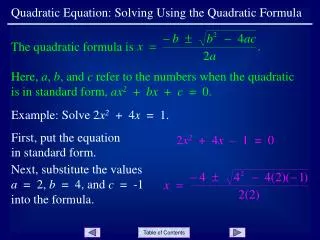
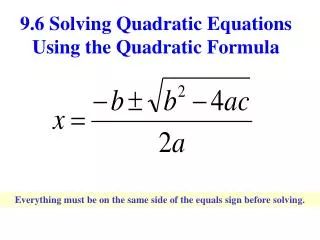
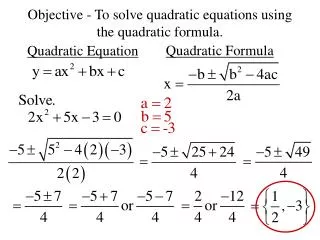
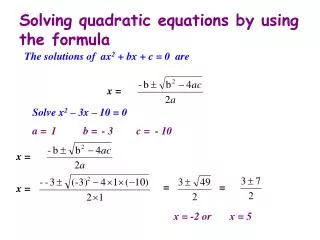
Solving quadratic equations by using the formula The solutions of ax2 + bx + c = 0 are x = Solve x2 – 3x – 10 = 0 a = 1 b = - 3 c = - 10 x = = = x = x = -2 or x = 5
Solve 2x2 + 5x + 1 a = 2 b = 5 c = 1 x = x = = = x = or x =
Solve 3x2 + 6x - 1 a = 3 b = 6 c = -1 x = x = = = = = x = or x =
Number of solutions of a quadratic equation A quadratic equation ax2 + bx + c = 0 b2 – 4ac > 0 the equation has two solutions. b2 – 4ac = 0 the equation has one solutions. b2 – 4ac < 0 the equation has one solutions.
Find the discriminant of 3x2– 2x + 5 and hence show that 3x2– 2x + 5 = 0 has no real solutions. Compare the quadratic expression with ax2 + bx + c and identify a, b, and c a = 3, b = –2, c = 5 Evaluate the discriminant b2– 4ac Apply the appropriate discriminant property 3x2– 2x + 5 = 0 has no real solutions.