Download
1 / 18
180 likes | 309 Vues
This presentation from Eastbourne in October 2005 discusses two years of experiences with the Graz kHz Satellite Laser Ranging (SLR) system. It highlights the system's stability and performance improvements, including increased return numbers and accuracy with kHz lasers. The presentation covers tracking of satellites like Champ and GPS, showcasing the advantages of higher firing rates. Key findings include successful measurements of satellite spin and significant enhancements in data retrieval compared to traditional methods. The content explores issues, status updates, and future plans related to kHz SLR.

E N D
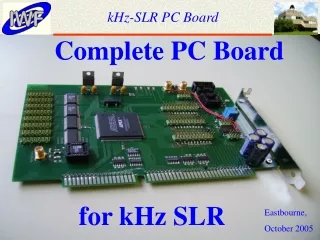
Moving to kHz Ranging • kHz Experiences in Graz • SLR 2000 Status & Issues • Herstmonceux kHz Status • Complete PC Board for kHz SLR • Others ? • Discussion, Questions, Plans … Eastbourne, October 2005
kHz Ranging: Graz Experiences • 2 Years Experience • with the • Graz kHz SLR System Eastbourne, October 2005
2 years kHz Ranging: • Fully operational since 2 years, day and night; • All satellites - from Champ to GPS 35 / 36 – are tracked; • Routinely 2000 Hz used (lower repetition rates would be possible, but are never used ...); • Laser System is running very stable; • Pump Diodes: Now 6000 hours, still perfect ... • Results: NOT ONLY (big) increase in return numbers; • EVERYTHING has improved significantly: • Stability; Single Shot RMS; Accuracy; • Additional Outputs Results … Eastbourne, October 2005
2 years kHz Ranging Experiences in Graz (1): • kHz SLR gives lot of returns (million !) – even with J lasers ! • kHz lasers are DPSS (Diode Pumped Solid State) units: • (... like changing from tubes to transistors ) • They deliver very stable, very uniform pulses; • They can deliver short pulses (10 ps in Graz); • This results in 2-3 mm SS RMS: • For CAL AND for – some – satellites (Grace, Champ..) Eastbourne, October 2005
kHz Ranging: Grace SS RMS 10 Hz Laser kHz Laser
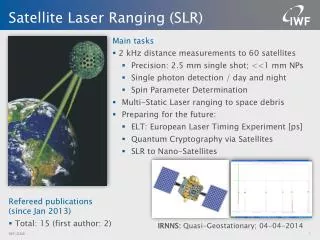
2 years kHz Ranging Experiences in Graz (2): • With kHz, you get not only more and better returns,but also additional information: • You can „see“ single Retro-Reflectors; • With up to 100 k pts/NP: Single-NP-statistics ??? • You can „see“ satellite spin and measure its parameters ! Eastbourne, October 2005
Ajisai Spin Determination • AJISAI: Retro panels seen at variable distances; • AJISAI rotates (0.51 Hz); • @ 10 Hz: Big Sat Signature; @ kHz: Single Retro Motion visible Eastbourne, October 2005
kHz Ranging: AJISAI Spin • AJI26907 • Daylight • 300 k pts Eastbourne, October 2005
Ajisai Spin Determination • AJISAI • 10 secs offull pass: • 11 k rets Eastbourne, October 2005
Ajisai Spin Determination AJISAI: 2.5 secs of full pass; 3 k rets; Spin: 0.51 Hz Eastbourne, October 2005
kHz Valibrations: Single Shot RMS 10 Hz 2 kHz
kHz Ranging: Graz Experiences • High Orbit Satellites, e.g. GPS 35 / GPS 36: • Difficult to track for most SLR stations; • Low return quotes; • Not many stations get daylight GPS returns … • kHz: Also advantages for GPS 35 / 36 Tracking: • Acquisition is faster, easier with kHz laser; • More returns / NP from GPS than with 10 Hz lasers; • Day and night: Very similar results; Eastbourne, October 2005
kHz Ranging: GPS 35/36 • GPS-35: • - Daylight Pass; • - 12 k pts remaining; • - Down to 47° Elev. • - 4.5 mm RMS
kHz Ranging: Graz Experiences • Additional Information / all presentations of the kHz Workshop 2004 in Graz available at: http://khzslr.oeaw.ac.at/presentations.htm Eastbourne, October 2005
kHz Ranging: Graz Experiences Conclusion: The kHz Poem .... Kilo-Hertz is lot of fun ! At least if all the work is done It DOES make sense – you should NOT wait … You should increaseyour firing rate !!! Eastbourne, October 2005