Understanding Recursion: Concepts, Benefits, and Pitfalls in Computer Science
This educational resource explores recursion in detail, including direct and indirect function calls. It discusses the advantages of using recursion, such as easier code writing and understanding, while also addressing common pitfalls like infinite recursion and stack overflow exceptions. The document emphasizes the fundamental rules necessary for effective recursive programming, illustrated with examples like the Fibonacci sequence and the Towers of Hanoi problem. Additionally, it compares recursion with iteration and outlines key points for implementing recursion effectively in programming.

Understanding Recursion: Concepts, Benefits, and Pitfalls in Computer Science
E N D
Presentation Transcript
Recursion Part 3 CS221 – 2/27/09
Recursion A function calls itself directly: Test() { … Test(); … }
Recursion Or indirectly: Test() { … Test2(); … } Test2() { … Test(); … }
Recursion vs. Iteration • Is recursion usually faster? • Does recursion usually use less memory? • Why use recursion?
Recursion Benefits • The code can be easier to write • The code can be easier to understand • Recursion can be a powerful problem solving technique
Recursion Pitfalls • Infinite Recursion • No exit condition == stack overflow exception • Performance • Recursion has method call overhead
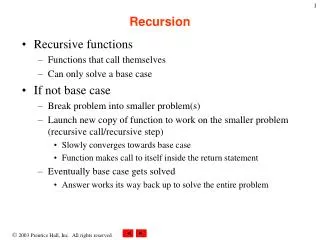
Rules of Recursion • Must have a base case (or exit condition) • Each recursive method call must make progress toward an eventual solution
Rules of Recursion Is it broken? void printInt( intk ) { System.out.println( k ); printInt( k - 1 ); }
Rules of Recursion How about now? void printInt( intk ) { if (k == 0) { return; } System.out.println( k ); printInt( k - 1 ); }
Rules of Recursion Fixed? void printInt( intk ) { if (k <= 0) { return; } System.out.println( k ); printInt( k - 1 ); }
Recursive Thinking • When a recursive call is made, the method clones itself • Code • Local variables with initial values • Parameters • Leaves behind a marker of where to return • When the call returns, the clone is destroyed and you return to the previous marker
How Method Calls Work • Java maintains a stack of activation records • Method parameters • Local variables • Return address • When a method is called, this activation records is pushed on the stack • When a method returns it is popped from the stack and execution returns to the return address
Example Method (non-recursive) • void printChar( char c ) { 2. System.out.print(c); 3. } • void main (...) • { 6. char ch = 'a’; 7. printChar(ch); • ch = 'b’; • printChar(ch); 10. }
Question What is printed? void printInt( intk ) { if (k <= 0) { return; } System.out.println( k ); printInt( k - 1 ); }
Question Now what is printed? void printInt( intk ) { if (k <= 0) { return; } printInt( k - 1 ); System.out.println( k ); }
Question What is printed? Void printTwoInts(intk) { if (k == 0) { return; } System.out.println(“Before recursion: “ + k); printTwoInts(k-1); System.out.println(“After recursion: “ + k); }
Result Before recursion: 3 Before recursion: 2 Before recursion: 1 After recursion: 1 After recursion: 2 After recursion: 3
Fibonacci Revisited Fibonacci can be defined as follows: • Fibonacci of 1 or 2 = 1 • Fibonacci of N (for N>2) = fibonacci of (N-1) + fibonacci of (N-2) • Iterative vs. Recursive…
Iterative Fibonacci Int fib (intn) { int k1, k2, k3; k1 = k2 = k3 = 1; for (intj=3; j<=n; j++) { k3 = k1 + k2; k1 = k2; k2 = k3; } return k3; }
Recursive Fibonacci int fib (intn) { if ((n==1) || (n==2)) { return 1; } else { return (fib(n-1) + fib(n-2)); }
Fibonacci Compared • The recursive version is: • Shorter • Clearer • Much slower
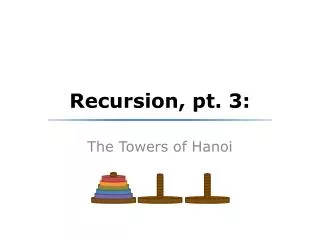
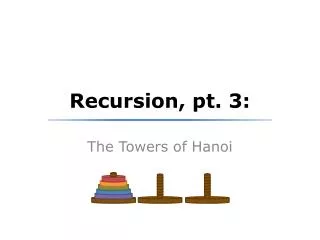
Towers of Hanoi • Especially impressive display of recursion! • If you understand the towers, you’ll understand recursion • Given three posts (towers) and n disks of decreasing sizes, move the disks from one post to another one at a time without putting a larger disk on a smaller one.
How do we get there? • We want to move all disks from peg A to B
Step 1 • Move all but largest from A to C
Step 2 • Move largest from A to B
Step 3 • Move the rest from C to B
PseudoCode Tower(disk, start, finish, spare) If disk == 0 then Move disk from start to finish Else Tower(disk-1, start, spare, finish) //Step 1 Move disk from start to finish //Step 2 Tower(disk – 1, spare, finish, start) //Step 3
Question • What is the time complexity? • What is the space complexity?
The Tower Legend • Legend has it that when the 64 disk problem is solved the world will end. How long will that take? • 2^64 moves = 1.845x10^45 • One move per second • 600 billion years….
Key points • Use recursion to improve code clarity • Make sure the performance trade-off is worth it • Every recursive method must have a base case to avoid infinite recursion • Every recursive method call must make progress toward an eventual solution • Sometime a recursive method will do more work as the call stack unwinds