
Edman Degradation and Mass Spectrometry Analysis of Phosphorylated FOXO3a Peptides
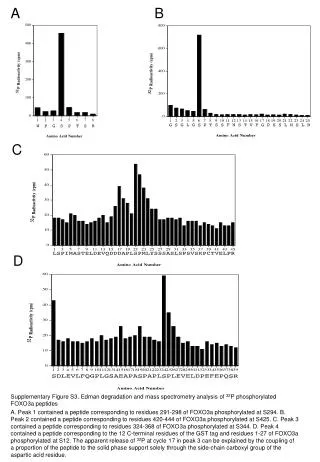
This study investigates the phosphorylation sites of the FOXO3a protein using Edman degradation and mass spectrometry. Four peaks were identified, each corresponding to specific phosphorylated regions: Peak 1 (residues 291-298 at S294), Peak 2 (residues 420-444 at S425), Peak 3 (residues 324-368 at S344), and Peak 4 (12 C-terminal residues of the GST tag and residues 1-27 at S12). Notably, the apparent release of 32P at cycle 17 in Peak 3 suggests that coupling to the solid phase support may occur through the aspartic acid side-chain carboxyl group.

Edman Degradation and Mass Spectrometry Analysis of Phosphorylated FOXO3a Peptides
E N D
Presentation Transcript
A B C D Supplementary Figure S3. Edman degradation and mass spectrometry analysis of 32P phosphorylated FOXO3a peptides A. Peak 1 contained a peptide corresponding to residues 291-298 of FOXO3a phosphorylated at S294. B. Peak 2 contained a peptide corresponding to residues 420-444 of FOXO3a phosphorylated at S425. C. Peak 3 contained a peptide corresponding to residues 324-368 of FOXO3a phosphorylated at S344. D. Peak 4 contained a peptide corresponding to the 12 C-terminal residues of the GST tag and residues 1-27 of FOXO3a phosphorylated at S12. The apparent release of 32P at cycle 17 in peak 3 can be explained by the coupling of a proportion of the peptide to the solid phase support solely through the side-chain carboxyl group of the aspartic acid residue.