Download
1 / 17
170 likes | 287 Vues
This chapter delves into the Moon's fundamental properties, including its size, mass, and surface features. The Moon, with a diameter of 3,476 km and a mass just 1.23% that of Earth, features craters and maria formed from ancient volcanic activity. It explores the lack of an atmosphere and tectonic activity, as well as the Moon's internal structure, including its crust, mantle, and core. Human exploration milestones, including the Apollo missions, are highlighted, alongside future lunar exploration ambitions. Learn about the Moon’s formation through the collisional-ejection theory and its dynamic relationship with Earth.

E N D
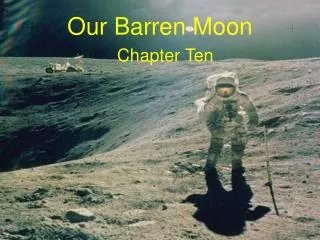
Our Barren Moon Chapter Ten
Introduction To Modern Astronomy I:Solar System ASTR 111 – 003 Fall 2007 Lecture 09 Oct. 29, 2007 Introducing Astronomy (chap. 1-6) Ch7: Comparative Planetology I Ch8: Comparative Planetology II Ch9: The Living Earth Ch10: Our Barren Moon Ch11: Earthlike Planets Ch12: Jupiter and Saturn Ch13: Satellites of Jupiter & Saturn Ch14: Uranus, Neptune and Beyond Ch15: Vagabonds of Solar System Planets and Moons (chap. 7-15) Chap. 16: Chap. 28:
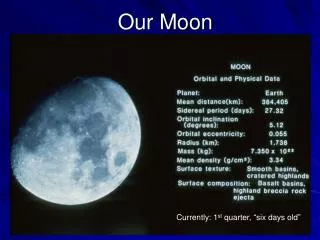
Earth-Moon System • Diameter: 3476 km, or 27% of Earth • Mass: 1.23% of Earth Mass • Density: 3344 kg/m3 • Average distance: 384,400 km, or ~ 30 Earth diameter • Round-trip of light: 2.6 sec • Spacecraft at 10 km/s: 10 hours • Car at 60 mi/hr: 167 days • Elliptical orbit: eccentricity 0.05 • Inclination of orbit to ecliptic: 5° • Inclination of lunar equator to orbit: 7°
Earth-Moon System FLASH • Liberation: • The synchronous rotation of Moon is not perfect. • It wobbles slightly, rocking back and forth around its north-south axis and nodding up and down in a north-south direction. • The liberation permits us to view 59% of the Moon’s surface • The liberation is caused by the Moon’s non-circular orbit and the inclination angle • Earth and Moon both orbit around a point between their centers called the center of mass • The center of mass is very close to the Earth’s center
Moon’s Atmosphere • None • The gravity is too weak to retain any atmosphere
Moon’s Surface • Extremely old surface • Covered with numerous craters, e.g, 30,000 craters larger than 1 km/s • These are impact craters. • no plate tectonic activity on the Moon • Moon is too small to retain internal heat • The entire crust is a single plate FLASH
Moon’s Surface • Maria (mean “sea”) • the dark area • low-lying plains • 15% of surface 2. Highlands • the light-colored area • highlands on the Moon • 85% of surface
Moon’s Surface • Maria • Maria have relatively less denser craters • Maria (~ 4.0 billion years) are relatively younger than highlands (~ 4.5 billion years). • Mare basin was caused by impacts of very large meteoroids or asteroids at a later time (~ 4.0 billion years ago) • Lunar crust is cracked by the large impact, causing lava flooding the basin • dark color is due to solidified lava
Human Exploration • From 1969 to 1972, 12 astronauts walked on the Moon, through 6 successful manned landings • July 21, 1969, 2:56 UTC, Armstrong put his left foot on the surface, and spoke • That's one small step for (a) man, one giant leap for mankind.
Human Exploration • About 400 kg of lunar materials have been brought back by Apollo astronauts • Seismic equipment have been put on the Moon to detect moonquakes and deduce the structure of the moon’s interior • Mirrors have been put on the Moon to measure the accurate Earth-Moon distance using Laser light: moon spiraling away at 3.8 cm/year
Human Exploration • The second race to the Moon • Aim to set up large and permanent bases • NASA’s Constellation Project • Send astronauts back to Moon in 2018 • Build a large scale Moon base in the next 25 years • China’s Chang’e project • Chang’e 1 launched on Oct. 24, 2007 • Japan’s moon project • Kaguya spacecraft launched on Sep. 14, 2007
Internal Structure • Like the Earth, the Moon has crust, mantle, and core • Core: • ~700 km in diameter, relatively small • iron rich, partially liquid • not producing global magnetic field • Moon’s solid lithsophere is about 800 km thick • In contrast, the Earth’s lithosphere is only 50 km thick • Therefore, Moon has no plate tectonics
Moonquake • Moonquakes are measured by seismometer set up by astronauts • Moonquakes are rare in frequency and small in scale • Originate 800 km below the surface, marking the boundary between solid lithosphere and plastic asthenosphere • The moonquakes are caused by the Earth’s tidal force • Tidal force deforms the solid body of the Moon • The force is greatest when the moon at perigee (most frequent quakes are observed) • The force is weakest when the moon at apogee
Formation of the Moon • Collisional-ejection theory: • the proto-Earth was struck by a Mars-sized protoplanet • debris from this collision coalesced to form the Moon • This theory explains • Low density of Moon • Small core of Moon • Because the Earth’s iron has sunk to its center due to chemical differentiation, little iron would have been ejected from the surface FLASH
Formation of the Moon • Collisional-ejection theory:
Tidal Forces • The Earth’s tidal force on the Moon produces the synchronous rotation of the Moon • The Moon’s tidal force on the Earth slows down the Earth’s rotation, through the friction between Earth and its bulged oceans; 0.002 sec per century
Final Notes on Chap. 10 • There are 5 sections in total • Section 10-4 (on Moon rocks) is not covered