Download
1 / 17
170 likes | 278 Vues
This comprehensive guide delves into the fundamental concepts of acids, bases, and pH. It explains the significance of the Henderson-Hasselbalch equation, the nature of reversible reactions and equilibrium, and the importance of buffers in maintaining pH levels in various solutions. The behavior of HCl in water is examined, showing the formation of hydronium ions. We also discuss the Brønsted-Lowry and Arrhenius definitions of acids and bases, alongside key equations and applications in electrochemistry. Learn about buffer capacity and the role of pH in chemical reactions.

E N D
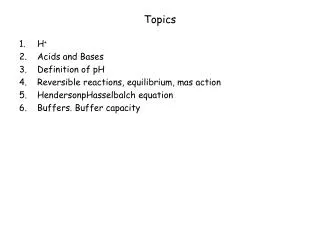
Topics • H+ • Acids and Bases • Definition of pH • Reversible reactions, equilibrium, mas action • HendersonpHasselbalch equation • Buffers. Buffer capacity
H+ Suppose chloride acid dissolved in water HCl H+ + Cl- The entity H+, hydrogen stripped from the electron, is simply a proton, without electronic cloud, with dimensions at least 4 orders smaller than a real atom. Its strong electrical field Impedes a free existence. What really happens, upon dissolution of HCl in water is: HCl + H2O H3O+ + Cl- H3O+ H2O + H+ HCl H++ Cl- [H+]
Rutherford-Thompson atom: Dimensions 10-15(Fermi) 10-10 (Å) m
Acids and Bases Brønsted-Lewy Concept (1923) Acid HA H+ + A- Base B- + H+ BH Arrhenius Concept (1890) Acid HA H+ + A- Base COH C+ + OH- Acid + base salt + water 2NaOH + H2SO4 Na2SO4 + 2H2O Water has amphoteric character 2H2O H3O- + H+
pH, reversible reaction, equilibrium, mass action pH Reversible Reactions – Rate constants - Equilibrium BA B + A K1 k-1
Henderson-Hasselbalch equation K1 k-1 HCl H+ + Cl- At equilibrium
Buffers and Buffer capacity In a given pH, β is a function of pH and buffer concentration
Bibliography • Bockris, J.O’M and Reddy, A.K.N.: Modern Electrochemistry. Plenum Press, 1970. Vol.1, 1970. Chap. 5. Protons in solution.
Questions • For a [H+] of 10-10M to 10-1M, in steps fo 10-3M, draw a plot of pH x [H+]. • Consider 1 L of a solution of a buffer of pK=7.5 amd concentration of 10 mM. Starting with a buffer base concentration of 9,9 mM, add progressively a strong acid, in amounts of 0.05 mmol. At equilibrium draw the curve relating pH to the total amount of acid added. Where is the point of maximal buffering power? • Suppose a buffer if pK=7.0 in concentration of 5 mM. What are the concentrations of acid and base for buffering a solution at a pH of 6,0.
Medidas de pH Eletródios Indicadoresfluorescentes Bibliografia Koryta, J.: Ion-Selective Electrodes. 1974. Cambridge University Press. Vanysek, P.> The glass pH electrode.The Electrochemical Society Interface. 2004 Lakowicz, J.R.: Principles of fluorescence spectroscopy. 2nd ed., 1999. Fluwer Academy/Plenum Press
Electrochemical potential of a solute in a phase – Macroscopic view Thermal energy T (K) C2 ø2 C1 1 C: concentration, mol/l Ø: Electrical potential, V M R= 8.3 J mol-1 K-1
Thermal energy – microscopic view Thermal energy Bezanilla simulation
+ + - - Campos elétricos – forças elétricas Força elétrica – lei de Coulomb Diferença de potencial elétrico Campo elétrico
Membrane (M) Properties C2 ø2 C1 1 M 1. Impermeable membrane 2. Membrane permeable to solutes =0 3. Membrane permeable to cations or to anions =0
Ion Exchangers – Glass Electrodes - - - - - - - - - - H+ H+ H+ H+ H+ H+ H+ H+ H+ H+ H+ H+ H+ H+ H+ H+ H+