Download
1 / 38
380 likes | 498 Vues
Engineering is a dynamic field that transforms math and science principles into practical solutions. It encompasses problem-solving, design, teamwork, and innovation. Engineers work in various sectors, developing everything from surgical instruments to municipal infrastructure and robotic systems for manufacturing. They collaborate with scientists to tackle real-world challenges. This field offers traditional programs like civil and mechanical engineering, alongside non-traditional pathways such as environmental and biomedical engineering. A career in engineering opens doors to impactful innovations that improve everyday life.

E N D
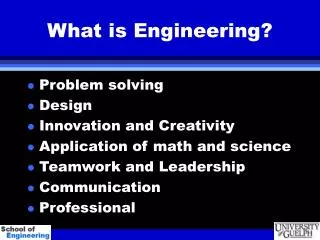
What is Engineering? • Problem solving • Design • Innovation and Creativity • Application of math and science • Teamwork and Leadership • Communication • Professional
What do Engineers do? • Work in industry, government or consulting • Develop surgical instruments • Design municipal infrastructure (water distribution lines, water treatment) • Remediate a contaminated site • Design a robotic systems for a production line in a factory
Engineer or Scientist – What’s the difference? • Science – understand concepts, learn about theory and principles, have expertise • Engineering – applies principles of math and science to solve real-life problems • Engineers and scientists often work together as part of a team • Engineering is a profession – P.Eng
Innovation in... • Waste management • Transportation • Communication • Production of: food, tools, machinery • Human health • Space travel and exploration • Computers in everyday life
Traditional Engineering Programs • Civil Engineering • Mechanical Engineering • Electrical Engineering • Chemical Engineering
Non-Traditional Engineering Programs • Industrial Engineering • Environmental Engineering • Biological or Biomedical Engineering • Engineering Systems & Computing • Computer or Software Engineering • Water Resources Engineering • Aerospace Engineering
Engineering at Guelph • Biological Engineering (Biomedical or bio-process areas of interest) • Engineering Systems & Computing (Biomedical, software or mechatronics areas of interest) • Environmental Engineering • Water Resources Engineering
OAC Requirements New Curriculum requirements OAC English ENG 4U 2 of OAC Physics, Chemistry and Biology 2 of PHYS, CHEM or BIOL OAC Calculus Advanced Functions and Introductory Calculus OAC Algebra & Geometry Geometry and Discrete Mathematics 1 additional OAC credit 1 additional grade 12 credit What do you need?
Design Engineering • Design courses starting in first year • First year - marble launcher • Second year - windmill powered battery charger • Third year - design of soccer playing robots • Fourth year design courses
The Mission: • Design, build and test a device to transport a marble from less than a foot off the floor into a column of water • Slow the descent of the marble to the greatest extent possible • Maximum time under water, not touching the bottom
The Rules: • You may attach a device to the marble • You may not change the marble • Human energy can only supply potential energy to the launch mechanism • If you add something to the water, it must be added with the marble • No explosives can be used
More Rules: • Made entirely by recycled materials • Constructed by the group • Total equivalent cost less than $50 • Safe for a nine year old to use • No animals may be used/harmed in the design
The column • Column 4 feet high • Water to within 2” of the top • A shallow sheet metal funnel will be attached to provide a greater entry radius • Launch mechanism can touch the metal funnel but not the column or the water
The Criteria • How long does the marble take to descend to the bottom of the water column • Cost (cheaper is better) • Aesthetic appeal • Simplicity of design • Unique, innovative design
What is Engineering? • Problem solving • Design • Innovation and Creativity • Math and science • Teamwork and Leadership • Communication
Solution 1 – Elastic launcher • Launching arm on an elastic band, potential energy by drawing back the arm launches the marble • Adjustable to change the range of the launcher and improve accuracy
Solution 1 – Cork floater • Marble attached to cork – buoyant forces counteract the weight of the marble • Flat piece of cork acts to provide drag in the water
Solution 2 – Weight pulley on a ramp • Weight (pop bottle filled with nails) attached by string to ½ popcan holding the marble flotation device over a pulley (old inline skate wheels) • As weight falls, the can with the marble leaves the floor, rises to the column and tips the marble device into the column
Solution 2 – Oil capsule • Spherical capsule filled with canola oil (lighter than water) • Fishing weights and paperclips to balance weight
Solution 3 Counter-weight lift device • Elevator type lift – wooden structure with a angled platform • Free weights attached by string to the platform • Once released from the top of the structure, the weights fall, and the platform rises, releasing the flotation device into the column
Solution 3 – Water balloon • Marble in a large water balloon, diameter slightly less than the diameter of the column • Attached to a PVC pipe capsule containing alka-seltzer • When balloon is released, water leaks into capsule through a drilled hole • Reaction with alka-seltzer releases gas, increasing the balloon diameter
The Winner • Solution 3 – Maximum suspension (5 min) • Second runner up – Solution 2 (4 min)
Biological Engineering • Applying engineering to biological systems • Food engineering • Biological processing • Biomechanics or biomedical applications • Ergonomic design applications • Students can mix and match
4th Year Design Projects • Project SOY – has included projects involving food coatings, alternate food packaging, SOY substitutes • Analysis and bioremediation of contaminated soils • Pedobarograph • Device for measuring forces during teeth grinding/Bruxism • Surgical Instrument for back surgery
Engineering Systems & Computing • Computer engineering (hardware) and Software engineering and Systems engineering • Embedded systems • Elevators • Microwaves • VCR • Car • Interaction – hardware, software, environment
4th Year Design Projects • Portable MP3 music machine • Robotic arm application where arms work in collaboration to complete a task • Intelligent mechatronic aide for recovering stroke patients • Voice recognition and translation • Home robot controlled via the internet
Research – Computer Vision Technologies • Robot that has vision and interacts with and tracks people • More sensitive than automated visual tracking • Applications – monitoring manufacturing, robotic arm routines and prevention of line shutdowns • GM – vehicle technology to prevent drivers from falling asleep, driver assistant for traffic surveillance
What is in our water? • Our water originates from lakes, reservoirs, groundwater and must be treated before use • Water recycling - Guelph’s wastewater is Brantford’s drinking water • Escherichia coli (O157:H7), Giardia lamblia, Cryptosporidium parvum
MERCURY VAPOR AND ARGON QUARTZ ENVELOPE TUNGSTEN ELECTRODE UV Disinfection
Visible Violet Red Cosmic rays Gamma rays X- rays Ultra- violet Radio waves Infrared X-rays Vacuum UV UV-C UV-B UV-A Visible l (nm) 100 200 300 400 800 What is UV light?
First Semester Second Semester Design I Mechanics Calculus I Calculus II Intro to Computer Programming Chemistry II/Programming II Chemistry I Physics History of Science Engineering Analysis The First Year